 HackerTube.runGood videos, with context.
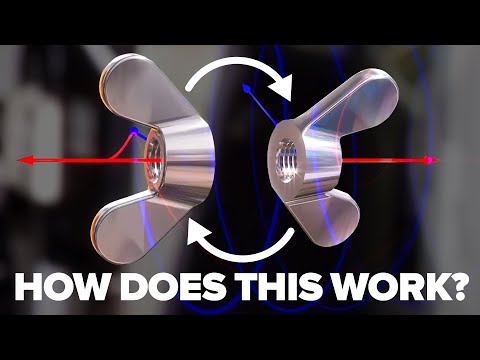
The Bizarre Behavior of Rotating Bodies
About this video
Veritasium explains the Dzhanibekov effect, also called the tennis racket theorem, where a spinning object flips unexpectedly about its intermediate axis. The video gives an intuitive account of the underlying rotational dynamics, drawing on Terry Tao's explanation and the original papers.
Why it appears in the archive
HN people cite it as the clearest layperson-friendly explanation of rotational instability whenever spinning bodies, tumbling objects or axis shifts come up.
AI-generated summary and labels from the source dataset; verify important details against the video. Source & credits.
From the Hacker News discussion
Not me. I only understand half your post, to tell you the truth. But Derek Muller on the youtube channel Veritasium has a good video on this, where he mentions how, when asked one time, Feynman couldn't think of a simple way to describe how it works, and then Muller goes on to explain it in a way that I could see. Great stuff: [VIDEO]
Read original comment ↗There are lots of university lectures, worked example problems, videos of people demonstrating and teaching every type of manual skill, .... on youtube > those videos are not educational This kind of thing is absolutely “educational” under any reasonable definition of the word [LINK] [LINK] [LINK] [LINK] [VIDEO] [LINK] Of course it’s not (and not supposed to be) a substitute for students working problems for themselves, running experiments, conducting interviews, doing research in the stacks, writing papers, writing code, putting each-others’ art through critique, or the like. Nobody “comes away from a Mathologer video thinking they «know math»” (whatever that is supposed to mean).
Read original comment ↗> Researchers monitored the known repeater FRB 121102 with the Lovell Telescope, a 250-foot-wide (76 meters) radio dish at Jodrell Bank Observatory in England, over the course of five years. They found strong indications of a 157-day activity cycle; 121102 seems to flare up for 90 days and then go silent for 67, the team reported in a new study. > It's unclear what's behind such cyclic activity, though scientists do have a few ideas. For example, periodic flare-ups could be caused by a wobble in the rotational axis of a highly magnetized neutron star known as a magnetar. Or they could be linked to the orbital motions of a neutron star in a binary system. Could this be the Dzhanibekov Effect ? Funny I just stumbled upon it today! [VIDEO] If Earth can maintain a stable axis, such wobbly oscillating axis could be that star's "normal". Just guessing! Or may be am too wrong. I am not a physicist!
Read original comment ↗You don't necessarily need gravity to make something tilt, it can happen naturally during rotation. For instance, imagine spinning something that distorts asymmetrically, like a pencil with some silly putty attached to one side. Alternatively, there's stuff like this: [VIDEO] . Angular momentum's always conserved, but the axis of rotation might not be.
Read original comment ↗I was just about to suggest the same thing. Here's a related Veritasium episode: "The Bizarre Behavior of Rotating Bodies" [VIDEO]
Read original comment ↗More seriously though, rotating habs are more difficult to spin properly than Clarke knew. The Russians discovered this and kept it to themselves. [VIDEO] I personally like the idea of spinning up large asteroids but the Dzhanibekov Effect will cause a lot of sloshing. If I understand it right, you have to spin them along the long axis, not like O’Neill cylinders. Two separate habitats at opposite ends of an air shaft. Clarke rings have to be careful about docking platforms. In fact they might need an inertially separate structure floating near them to handle loading and unloading of cargo, and then ferry materials back and forth across the “air gap” using very small vessels or robotic arms.
Read original comment ↗