 HackerTube.runGood videos, with context.
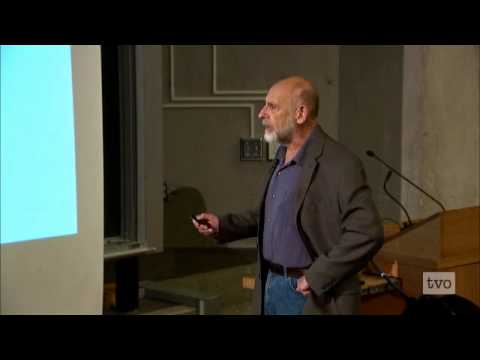
Leonard Susskind on The World As Hologram | TVO Docs
About this video
Stanford physicist Leonard Susskind gives a public lecture on the holographic principle, the indestructibility of information and the nature of black holes. It asks whether the world could be a hologram.
Why it appears in the archive
HN commenters recommend it as an accessible yet substantive introduction to the holographic principle and black hole information, often when related physics news comes up.
AI-generated summary and labels from the source dataset; verify important details against the video. Source & credits.
From the Hacker News discussion
I have found this Leonard Susskind lecture to come closest to answering the question of "why would anyone even suggest such a thing?" about this subject: [VIDEO]
Read original comment ↗Others can hopefully chime in with more, but when I first was learning about it, my reaction to the word "hologram" was the same as your (1). My understanding is that when they say "hologram", they're simply meaning an n dimensional object that's encoded in n-1 dimensional space. If you're not familiar with the basics of the Holographic Principle, start here: [LINK] It's been a while since I've watched these, but IIRC these are very good videos to start with: - [VIDEO] - [LINK] EDIT: Key clippings from the wikipedia article- " But Jacob Bekenstein noted that this leads to a violation of the second law of thermodynamics. If one throws a hot gas with entropy into a black hole, once it crosses the event horizon, the entropy would disappear. The random properties of the gas would no longer be seen once the black hole had absorbed the gas and settled down. The second law can only be salvaged if black holes are in fact random objects, with an enormous entropy whose increase is greater than the entropy carried by the gas. Bekenstein argued that black holes are maximum entropy objects—that they have more entropy than anything else in the same volume. In a sphere of radius R, the entropy in a relativistic gas increases as the energy increases. The only limit is gravitational; when there is too much energy the gas collapses into a black hole. Bekenstein used this to put an upper bound on the entropy in a region of space, and the bound was proportional to the area of the region. He conc
Read original comment ↗Black hole Firewalls with Sean Carroll and Jennifer Ouellette (45m+50s quick summary of the holographic principle) [LINK] Leonard Susskind on The World As Hologram (more dense/verbose) [VIDEO]
Read original comment ↗Since you asked for more depth, I'll focus on the (comparatively easier) task of giving some links to technical literature. First of all, if you already have a traditional QFT background, there's the two extremes of either just taking a simple toy example to play with [1] or a fairly rigorous well written lecture course [2]. For a more general physics/math background I'd recommend a slightly more pedagogical treatment [3], but it's still accurate to the subject matter and therefore contains graduate level mathematics. There's a lot more out there, but these are just some of the descriptions I've personally skimmed and found them to be well written and useful. On the other end of the scale, there's a huge amount of popular documentaries out there that purport to say something about AdS/CFT. Most of them either contain nonsense or don't say very much at all. I don't really know how useful the popular analogies really are, but in the spirit of making at least one recommendation that doesn't contain any math, Susskind's public lectures are easy to watch (here's one [4]), and Susskind is careful not to talk nonsense. There isn't really much on AdS/CFT that's in between graduate level mathematics and math-less popular stuff. The reason is that it's a fairly irreducible concept in the sense that you really need to understand what an anti-de Sitter space is and how conformal field theories work to see why there's a mathematical correspondence between them, and this isn't truly analog
Read original comment ↗Not sure if it's related but this lecture gave me some basic grasp on the notion of holographic representations [VIDEO]
Read original comment ↗Suskind actually has a whole lecture on Youtube devoted to addressing the paradox of falling into a black hole from the perspective of the person falling in versus an outside observer. The outside observer sees the falling observer catastrophically turned into high-entropy soup smeared across the horizon, while the one falling feels nothing particularly special as they cross the event horizon. [VIDEO]
Read original comment ↗There is a somewhat recent theory that supports this idea. It is unclear whether or not things actually fall-in, but the idea is that the entire surface is a hologram, and the surface alone is sufficient to describe the entire contents. (Thus preventing any information loss). Much better described here: [VIDEO]
Read original comment ↗To be completely honest - There is no straight answer. One modern answer was that particles falling into a black hole would appear to be destroyed for outside observer (in a vortex of fire) while the observer would be scrambled into a holographic representation (keep in mind ashes would be a highly energetic representation of same observer). See [LINK] [VIDEO]
Read original comment ↗