 HackerTube.runGood videos, with context.
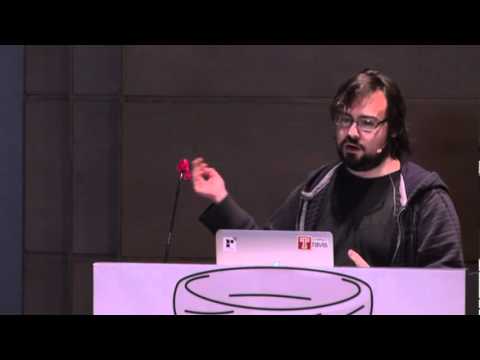
Yehuda Katz - Why Rails is Hard (Railsberry 2012)
About this video
Yehuda Katz's Railsberry 2012 talk on why Rails is hard to learn and use. He explains that the framework's many features reflect real complexity in web applications that newcomers do not yet see.
Why it appears in the archive
Recommended to people who call Rails bloated, as an argument that its size comes from features you eventually need.
AI-generated summary and labels from the source dataset; verify important details against the video. Source & credits.
From the Hacker News discussion
I would gladly take Flask over Django/TastyPie Could you explain the benefits or difference for you? Personally, I enjoyed using Tastypie, and when things weren't clear, its code was a pleasure to read and made things easier to understand or work out how to solve. Perhaps similar to your experience with the Flask code. I imagine a thinner framework is cleaner in many ways, but then with a more robust framework you get stuff out of the box. In this particular case, getting the request time (+ if you want, sql time etc) is relatively easy and there are a few middleware options to do it in Django. I've seen an interesting talk[1] by Yehuda Katz: "why rails is hard". One of the key points, if I can somehow paraphrase, is that with a bigger framework like rails, you get a lot more out of the box for the 'price' of it being heavier... He's comparing rails to node and sinatra, but the same might apply to the comparison between django/tastypie and flask I suppose. Finally, I don't know about flask, but another important point in Yehuda's talk was that some of those things implemented for you, you might not even know that you need. This is true particularly for security, where you probably don't have to think about whether XSS/CSRF protection is implemented etc, you just want things to be secure by default and it's not a feature you even think about... I am not saying flask doesn't have those (I don't know), just that in general that's usually the trade-off between heavier and lighter
Read original comment ↗Rails is not bloated, it just comes with a lot of features. I'd suggest watching these videos. [VIDEO] [LINK] A typical Rails instance will use 100 - 150mb, and does not take a minute to start up. Have you actually used Rails? I have several large projects and none have ever taken that long to startup. I use Ruby for non Rails projects all the time and had no issue finding how to include Active Record and Action Mailer into a Ruby CLI application.
Read original comment ↗(Un)conscious (in)competence reminds me of Donald Rumsfeld's trichotomy of known knowns, known unknowns and unknown unknowns. (highlighted here: [VIDEO] )
Read original comment ↗The difference is that Rails and the popular gems involve some of the highest abstractions I've ever used. It's like that by design. There's nothing inherently bad about it. Here's the typical workflow for adding a gem: 1. Add "gem 'some_library'" to Gemfile 2. `bundle install` 3. Drop the 'some_library_method!' incantation where you need to. Here are the steps for Devise's base-case (I only use Devise as an example for a broader point): 1. echo 'gem "devise"' >> Gemfile 2. `rails generate devise:install` 3. `rails generate devise User` 4. `rails generate devise:views` Boom. It's awesome. The trade-off is that now your entire authentication system is hidden behind line 37 of your Gemfile. And that's Devise's purpose - to be that abstract. And on many projects that's perfectly fine. Of course, you can roll your own authentication in Rails. It's easy. It's not like you have to use Devise or a daisy-chain of opaque libraries. But I find it nontrivial to understand what Rails does behind the scenes. Or what `require "activerecord"` in Sinatra does behind the scenes. Or how to recreate a state of my application. Or how to test things without a testing abstraction. And I didn't really care until I started to care. Ring's functional abstraction has helped me remain aware of what my application is doing. My application state is annotated clearly as `(def ^:dynamic current-user )` which is bound to every request by plucking the value of the `:session` key out of the request map. My ap
Read original comment ↗