 HackerTube.runGood videos, with context.
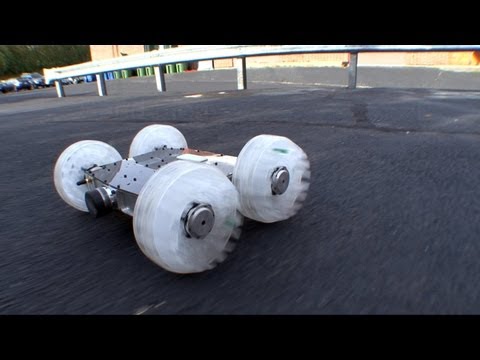
Sand Flea Jumping Robot
About this video
A short Boston Dynamics clip of the Sand Flea, an 11-pound RC-car-style robot that can jump about 30 feet into the air. An onboard stabilization system keeps it oriented in flight and for landings.
Why it appears in the archive
Brought up as a favorite and as an inspiration for small, cheap jumping robots for obstacle crossing and planetary exploration.
AI-generated summary and labels from the source dataset; verify important details against the video. Source & credits.
From the Hacker News discussion
Aha, Boston Dynamics has such wild repertoire of robots. Well done. Forget Big Dog, I like this robot a lot: [VIDEO] Maps, Self-Driving car, robots and a high quality analytics team. On top of that, robotic team comprises of various reputed groups with talented well regarded individuals. I look forward to the future. Also, how much disparity will arise in quality of living between North America and various Asian countries, or even Europe.
Read original comment ↗Have you seen the robots they developed? Reducing it to "moving from point A to B" is misleading, in my opinion, even if technically true. They essentially developed machines that could move in difficult terrains, often where humans themselves couldn't. My favorite is the Sand Flea, a small car which can jump 9 meters (30-feet) into the air: [VIDEO]
Read original comment ↗How is it practical? It's a beautiful design, but far simpler designs can run circles around it in every scenario I can imagine. A small version might make for a fun desk toy. When I think practical, I think Boston Dynamics. [LINK] [VIDEO]
Read original comment ↗Yes, a robot that can jump on top of a building in 1 jump sounds more useful to me, something like this one: [VIDEO] .
Read original comment ↗So if it falls on its side, something that has a probably a 50% chance of happening, can it get back up? I always thought that for exploring another planet, you shouldn't really use something with wheels or wings. Something different like small "jumping robots" would make a lot more sense in a place where you have literally the ability to do 0-hardware maintenance. Instead of a single expensive flying robot, why not send a fleet of these little small jumping-robots instead, to more quickly and cheaply explore the area: [VIDEO]
Read original comment ↗A slightly larger version of Sand Flea seems like a better fit. Disposable, can be deployed relatively cheaply in large quantities, with good camo nearly invisible on the ground, can scale obstacles by jumping. Could be made to carry a fragmentation payload and/or spy gear. [VIDEO]
Read original comment ↗Boston Dynamics tackled this problem with the SandFlea robot ca. 2010, albeit in a single axis while exploiting the intermediate axis theorem. You can see it in action @ 0:17 in their sole released video[1], where the robot snaps flat during the ascent phase. This was done primarily to increase the likelihood that the vehicle would land on all four wheels, in order to maximize energy dissipation by the wheels on landing and thus minimize shock seen by the body. As a secondary benefit, footage from the onboard camera stood a chance to be usable during a hop, instead of being a blurry mess. Lots of great details in their patent filing for the robot[2]. Source: I helped design this robot [1]: [VIDEO] [2]: [LINK]
Read original comment ↗Here's a Boston Dynamics one that is less than a foot long, 11 pounds, and can jump 30 feet (easily from ground to roof of one story building) [VIDEO]
Read original comment ↗