 HackerTube.runGood videos, with context.
A Tour of Prolog
About this video
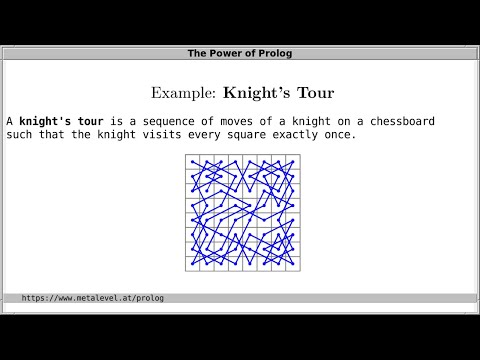
Markus Triska tours Prolog's most distinctive features, including its use as a database and query language, rule processing, constraint solving and compile-time rewriting. It also covers concise meta-interpreters.
Why it appears in the archive
HN recommends it as the best short introduction to what makes Prolog unique.
AI-generated summary and labels from the source dataset; verify important details against the video. Source & credits.
From the Hacker News discussion
The Power of Prolog [0] is a fantastic blog/video series covering everything from basic syntax, theoretical basis, modern features and idiomatic constructs. I highly recommend it if you want to get the gist of Prolog and its modern features. If you want a tour of Prolog, you can watch the video with the same name [1]. [0]: [LINK] [1]: [VIDEO]
Read original comment ↗I think that Prolog will rise again. If you have an hour to kill, check out this video introduction by Markus Triska about what makes Prolog unique: [VIDEO] Recently I have been working on getting Trealla Prolog to run in WebAssembly. Support is quite good now, with an easy-to-use JS library[1], Go library[2], and is now one of the best-supported languages for the Spin runtime[3]. I think it's particularly nice for validations, you can write some simple Prolog rules and run the same code on the client and the server now. I would like to explore this more with a dedicated library at some point. Built-in features like DCGs make parsing/generating all kinds of data trivial. I love it. I think the biggest barrier to Prolog adoption is that it has a really steep learning curve, and most people get burnt by half-assed introductions in college that tick the 'talked about logic programming' box in the syllabus. You really have to think in a completely different way to write a good Prolog program. But, once you get the right mindset, it makes solving complex problems incredibly easy. I don't really buy the argument that Datalog is enough. Most Datalog implementations I've seen hack on a bunch of extensions to do things like list membership. It would be awesome to see some serious effort put into an efficient Prolog-based database. The closest thing I can think of is TerminusDB, which I've never used but I wish I could convince my company to try it out ;). My dream is to have some kind
Read original comment ↗I was watching some of the videos and in the intro Markus mentioned some of the most popular Prolog systems [VIDEO] SICStus, GNU Prolog, XSB, Ciao, Scryer, Traella, Tau but does not mention at all of SWI-Prolog. I remember using SWI-Prolog back in the day, did it somehow fall out favor, or is there some animosity between implementation and Markus is just not in the SWI-Prolog camp?
Read original comment ↗