 HackerTube.runGood videos, with context.
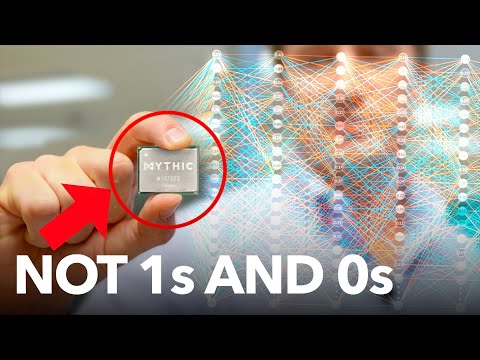
Future Computers Will Be Radically Different (Analog Computing)
About this video
Veritasium explains why analog computing may suit AI workloads, covering old analog computers, The Analog Thing and Mythic's analog chips that use flash memory for neural network inference. It argues digital hardware is hitting limits.
Why it appears in the archive
Treated as the accessible reference on analog computing for neural nets, especially the Mythic AI segment.
AI-generated summary and labels from the source dataset; verify important details against the video. Source & credits.
From the Hacker News discussion
Agreed. I've never really gotten into neural networks, most of the times I start but get distracted or bored/lost and suddenly enough a Vertiasium video pops up and about everything just slots into place, stuff you've glossed over or heard before just make sense. [VIDEO] . Start at minute 4:00.
Read original comment ↗basicly, we can do things like matrix operations and differntial equations using specialized hardware that performs computation over analog signals rather than buidlign discrete systems. the end result is that we dont' need anywhere near the level of compute to do the job as its done using an analog of the physical process. here's two youtube videos that explain is much better than I could. [LINK] [VIDEO] suffice to say, your average house fly exhibits behavior that absolutely dominates our best drones and with a fraction of the circuitry.
Read original comment ↗Great Veritasium video on YouTube about analog neuromorphic architectures and their promise for lower-power operations: [VIDEO]
Read original comment ↗It's a big area of research in AI. Veritasium has two great videos on it: [VIDEO] [LINK] I found a hackernews discussion for the second one: [LINK]
Read original comment ↗I found this Veritasium video interesting, about a company that is paring down models so they fit on analog chips, so the chips can be used in self-contained devices. It also appears that quantum computers may be even better for matrix math that transformers rely on. If all these hardware advances pan out... [VIDEO] [LINK]
Read original comment ↗Veritasium has a good video about analog computers. It covers how they work, what they are used for, pros and cons compared to digital, what they look like today, a bit of the history and their possible future. [VIDEO]
Read original comment ↗I think they're saying analog computers could be the future of computing. Veritasium explains it really well in general here (and demos the device) [VIDEO]
Read original comment ↗[LINK] This is a rather intuitive mathematical proof that neural nets can emulate all functions in many dimensions. Knowing integrals (Calc 102) would help. With this information it’s either that self-driving is eventually possible or human brains are not mathematically representable (i.e. something akin to a soul). Meanwhile, the data collection/storage is getting better (all Teslas are continually testing FSD and reporting failure cases, synthetic generation of “good and unique” perfectly labeled data[0] is only a year or two “old”). Sensors/cameras are improving (and have a lot more room to improve). The compute hardware is getting better and cheaper (analog computers[1], TSMC 2nm and beyond, Apple/Google/Teslas neural cores, etc). Additionally, given Waymo is already in production without humans in PHX it’s arguable that we already have “autonomous vehicles”. We now just need them to improve slightly and for Waymo or similar to test in the top 25 cities in the US. Which is mostly a matter of capital and time not technology limits. Maybe weather will be an issue for a few more years/decades - but even if Waymo only operated in Summer, I’d be happy to reduce my Lyft costs - and with enough data and maybe better sensors the neural nets will be able to handle weather too. Especially if the car just goes slow. [0] [LINK] [1] [VIDEO] [2] [LINK]
Read original comment ↗