 HackerTube.runGood videos, with context.
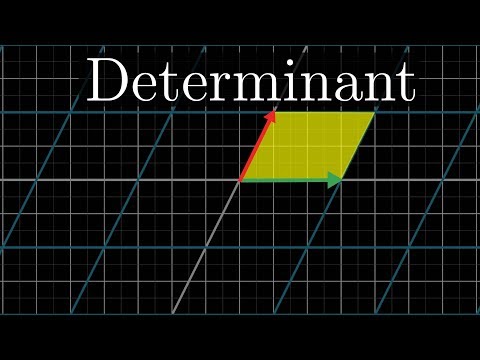
The determinant | Chapter 6, Essence of linear algebra
About this video
A 10-minute 3Blue1Brown chapter explaining the determinant as the factor by which a linear transformation scales area or volume. It builds the idea geometrically with animations before any formulas.
Why it appears in the archive
HN repeatedly points people to it as the clearest visual intuition for determinants, often saying it finally made the concept click.
AI-generated summary and labels from the source dataset; verify important details against the video. Source & credits.
From the Hacker News discussion
As someone who very much relates to the GP’s anecdote, I might suggest determinants as a good example. As an undergraduate studying maths, I encountered a standard theorem in one of my first courses, which says that about 947 different conditions are equivalent to a matrix having a determinant of zero. I dutifully memorised these. I also dutifully memorised the algorithm for how to calculate a determinant. I might even have remembered some verbatim proofs of some of the equivalences. However, I developed absolutely no intuition about what a determinant is . I had book knowledge, but no insight. It was a long time ago now, but I’m fairly sure that when I graduated I still did not truly understand even this very basic (by undergraduate standards) subject. I think it was probably a few years later, when I came across some of the same theory but in a much more practical context at work, that most of the connections in that equivalence theorem first “clicked”. Meanwhile, here is what a gifted presenter with the right illustrations can do in about ten minutes: [VIDEO] The 2,000 or so substantially identical comments below that video are very telling. Given the understanding you’d get with that quality of presentation, the equivalences I mentioned above would have been obvious and constructing the proofs from first principles would have been straightforward.
Read original comment ↗At the same time, universities could sometimes do a better job of letting students see why it's important to learn something. A great example is matrix determinant, which at first glance seems like an entirely arbitrary invention. The 3Blue1Brown YouTube channel does a great job with this, introducing the determinant in terms of geometry. It puts the geometric meaning of the function first, introducing the strange looking formula later on. edit And of course, it does all of this with excellent visualisations. [VIDEO]
Read original comment ↗Determinants always fascinated me, partly (completely?) because of the cool sounding name. I always wanted to get intuition for them because their formula is so simple, which has always been deeply unsatisfying to me to just take on its face. This article got me searching for a 3blue1brown video on determinants and now my mind is absolutely blown! [VIDEO]
Read original comment ↗The entire 3blue1brown series[0] on linear algebra is well worth watching, it has really intuitive graphical explanations of a bunch of concepts. Here's the one on determinants in particular[1]. TL;DW the determinant represents how much you scale the area/volume/hypervolume (depending on dimension) of a shape by applying a matrix transformation to each point. [0] [LINK] [1] [VIDEO]
Read original comment ↗To add to this, a website I've found useful is betterexplained.com. Specifically for complex numbers, take a look at [1] and [2]. But they also have good articles with visualizations to help you understand the Fourier transform, the number e, integrals and derivatives, linear algebra, etc. A starting point is [3]. One useful idea is that they color the different parts of math equations to explain each part separately, see [4]. Another great source of math visualizations is the YouTube channel 3Blue1Brown, in particular the series on linear algebra [5]. (I didn't intuitively understand what a determinant represented or what the determinant of a transformation being zero really meant, until watching [6].) [1] [LINK] [2] [LINK] [3] [LINK] [4] [LINK] [5] [LINK] [6] [VIDEO]
Read original comment ↗> The novel approach taken here banishes determinants to the end of the book. Big fan of this approach! Though I have warmed up to determinants ever since I saw 3Blue1Brown give a fairly intuitive explanation for them [0]. I'm kind of curious as to how they covered eigenvalues/the characteristic polynomial without determinants. Maybe they just jumped straight to diagonalization? [0] [VIDEO]
Read original comment ↗I strongly disagree skipping determinants provides a more intuitive approach to linear algebra. I don't know your background, but I'd venture a guess you feel it does because the Laplace expansion formula for computing the determinant[1] feels uninspired and out of place. The reason determinants are hard to teach (in my opinion) is because a rigorous derivation of their formula isn't possible without first teaching multilinear algebra and constructing the exterior algebra. Once you do those things, the natural geometric interpretation of the determinant basically falls onto your lap. But it's still very useful for e.g. computing eigenvalues and using the characteristic polynomial, so it's taught before that context can be formalized. Professors shouldn't teach determinants in the context of matrices, at least not at first. That's heavily computation-focused, and the symbol pushing looks really unmotivated and strange to students. Instead they should teach the basis-free definition of determinants (i.e. focus on the linear map, not the matrix transformation representing the linear map for some basis). Then the determinant is "only" the volume of the image of the unit hypercube under the linear transformation, which is where the parallelepiped comes in. If the linear transformation is invertible, the unit hypercube is transformed from an n -dimensional cube into an n -dimensional parallelogram, from which you can geometrically see the way the linear map transforms the entire ve
Read original comment ↗