 HackerTube.runGood videos, with context.
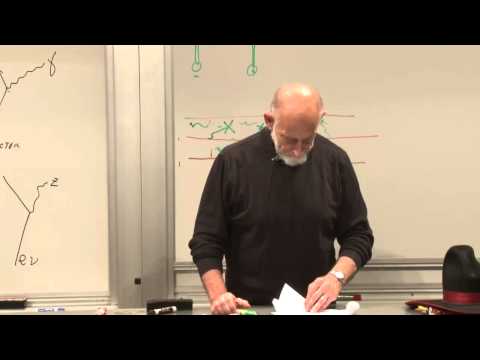
Demystifying the Higgs Boson with Leonard Susskind
About this video
Stanford physicist Leonard Susskind explains what the Higgs mechanism is and what it means to give mass to particles. He also covers what is at stake for physics and cosmology.
Why it appears in the archive
HN repeatedly recommends it as an approachable, math-light route to understanding mass and the Higgs field.
AI-generated summary and labels from the source dataset; verify important details against the video. Source & credits.
From the Hacker News discussion
If anyone is interested in the mechanics of the higgs field / basic quantum mechanics in general, I found this lecture to be an excellent explanation: [VIDEO]
Read original comment ↗The mass of the massive gauge bosons, the W and Z bosons. Edit: there is an excellent in-depth (but math-light) explanation about the Higgs mechanism by Leonard Susskind. I highly recommend it if you are interested, it lasts about 1h (plus some Q&A) and is extremely approachable, while being presented by an established authority in the field. [VIDEO]
Read original comment ↗If you're interested in the Higgs mechanism as a layman, I highly highly recommend this talk by Leonard Susskind: [VIDEO] It's about 1 hour long (plus some questions) and it goes through some basic ideas of what it means for something to have mass and all the way to the Higgs mechanism.
Read original comment ↗If anyone wants to dig deeper, there is an excellent lecture on YouTube by Leonard Susskind. This goes into some details on how fields in general give mass to (composite) particles, and how the Higgs field has certain properties that allow it to give mass to elementary particles. It goes only into a tiny bit of math, absolutely intelligible at the high-school or at least undergraduate level. [VIDEO]
Read original comment ↗> no one really knows what mass is. We only know that mass bends space-time curve, hence gravity. Mass is much better understood by its role in inertia. Basically mass is the amount of energy you need to exchange with a thing to change its current speed. This observation works from Newtonian mechanics to QM and GR as well. Now, why do things have mass? The famous E=mc² explains this for most things: they have mass because something inside them has potential or kinetic energy. This works all the way down to the atomic level - the mass of a proton for example is almost entirely explained by the potential energy of the quarks being held together in a small volume; the total mass of the quarks themselves is only a small fraction of that. Now, the mass of the elementary particles is somewhat more complicated, but the Standard Model does have explanations for those - symmetry breaking for fermions, and the Higgs mechanism for the massive bosons. The next mystery is: why is inertial mass equal to gravitational mass? GR has essentially explained this, by showing that acceleration is equivalent to gravitational attraction depending on your frame of reference. So overall, I'm not sure what Brian Greene means by that - mass is at least as well understood as other basic properties of particles (charge, spin, color charge). This lecture by Leonard Susskind explains most of these things about mass in a way I found easy to follow: [VIDEO]
Read original comment ↗The quarks that are bound in a way we call a proton are held together by the strong force at a certain distance from each other - that distance is what we consider the volume of the proton, with the quarks being "inside that volume". This system of 3 quarks has some amount of potential energy, and/or some amount of kinetic energy from the relative movement of the 3 quarks. The mass of this system is then given essentially by E=mc^2, with E being this kinetic energy. There is a very good video of a lecture by Leonard Susskind that explains why energy and mass are interchangeable in this way if you want a more in-depth explanation: [VIDEO]
Read original comment ↗