 HackerTube.runGood videos, with context.
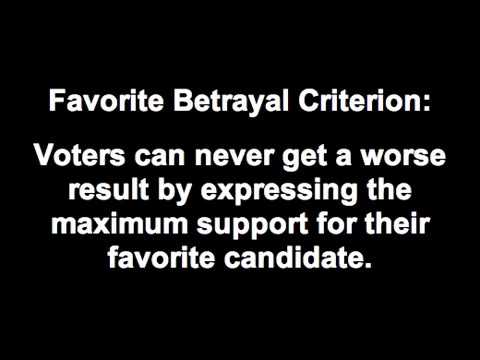
How our voting system (and IRV) betrays your favourite candidate
About this video
The Center for Election Science explains favorite betrayal in instant-runoff voting: in some elections, ranking your favorite first can cause your least favorite to win. It contrasts this with plurality voting's spoiler problem.
Why it appears in the archive
The standard link in ranked-choice voting threads to show IRV does not eliminate the spoiler effect.
AI-generated summary and labels from the source dataset; verify important details against the video. Source & credits.
From the Hacker News discussion
This issue has been solved by math PhD's and political scientists who've studied the matter for decades. www.electology.org/approval-voting-vs-irv IRV can elect X even if Y was preferred to X by an arbitrarily huge majority and got more first-place votes than X. www.electology.org/core-support Regarding favorite betrayal, you might enjoy this video. [VIDEO]
Read original comment ↗This is a shorter video from the same source as the other reply that deals specifically with IRV: [VIDEO] >Unless I misunderstand IRV, there is no "vote stealing" due to your vote automatically dropping off to your next-preferred candidate. The problem is that they drop to your next preferred candidate who has not been eliminated . If you're thinking about the problems that occur with plurality voting, it's easy to imagine your second choice will always be a popular "safe" choice, but if third parties get stronger (which is surely the point?) those safe choices can end up being eliminated before your second choice can help them.
Read original comment ↗I always recommend this pair of videos when discussing STAR voting vs other alternative systems. The first video is an easy-to-follow explanation of how spoiler effects can happen in both plurality voting and IRV [1]. In the second [2], the guy who created Star voting applies Ka-Ping Yee's methods to Star voting and animates it side-by-side with alternative systems to show its performance. [1] [VIDEO] [2] [LINK]
Read original comment ↗RCV doesn't solve what is claimed in the article. It is interesting since countries that they give as examples are clear evidence of this. (Yes, I'm going to advocate cardinal systems like Approval, Range/Score, and STAR) > More moderate candidates. RCV doesn't encourage this at all. Australia is a clear example of this. In the house Liberal and Labor (the two major parties) control 85% of seats. The next major party (National) is part of a coalition with the Liberals and this sums to 95%. Things are only slightly better in the senate. Look at any country that uses IRC/RCV and you'll see a similar pattern. The system didn't encourage more parties and more moderates, Australia still has divided politics like America. As to the more parties, I have an alternative explanation. They use a parliament, which uses proportionate representation. Don't buy it? Go look at countries with parliaments and don't have IRV and you'll find similar distributions. We also need to recognize that in America our parties are closer to coalitions in other countries out of the necessity. I'm not sure how anyone can look at someone like AOC or Sanders and think they are the same "party" (by other country norms) as Biden or Pelosi (similarly on the Republican side, though Trump caused a consolidation). > ranked-choice voting can drastically reduce the possibility of spoilers. Yes, but no. It reduces spoilers when a candidate is not going to win anyways (e.g. Jo Jorgensen spoiling Trump). But this does n
Read original comment ↗I agree with what /u/zestyping says in the other comment, so I won't repeat it. But here's a video explaining the strategic voting issue: [VIDEO] Also, wikipedia has an example of a non-monotonic result here: [LINK]
Read original comment ↗Yes, I understand how IRV works, and indeed I used to believe it was flawless. >There is no way that placing your preferred candidate first can ever result in your vote not being given in the order you choose. No, but it can end up harming your second choice, by eliminating them early, so your vote for them doesn't matter. This is called Favourite Betrayal, and it's a serious problem with IRV: [VIDEO] And as a quick worked example, if you have 4 people voting A>B>C, 4 people voting C>B>A and 3 people voting B>A>C, then A wins. If one person voting C>B>A changes their vote to B>C>A, then B wins. So by putting C first, they were harming their second choice B.
Read original comment ↗This is a great introduction to voting theory, but there are several notable omissions. The video doesn’t tell the whole story about what it presents as “ranked voting”, usually known as Condorcet voting. There are systems that always yield the Condorcet winner when one exists, and do a good job of resolving the unavoidable but rare preference cycles as consistently as possible. The most standard one is the Schulze method, which is used by the Debian, Ubuntu, and Gentoo projects, among many other organizations. [LINK] The video asserts that what it presents as “elimination voting”, usually known as instant-runoff voting, doesn’t suffer from the third-party spoiler effect. But that’s only true as long as the third party never gains enough support to have a real chance of winning. [VIDEO] (I wonder: can you think of a pair of powerful organizations who might want to ensure that third parties never gain enough support to have a real chance of winning? Hmmm.) Finally, the video doesn’t talk about approval voting or score voting, which use a different ballot type to which Arrow’s impossibility theorem does not apply. Some game theorists argue that these systems actually do a better job of finding the ideal Condorcet winner than Condorcet systems do, in the presence of strategic voting. [LINK]
Read original comment ↗The problem with Instant Runoff is called "Favourite Betrayal", where placing a party second can lead to them being eliminated before your vote for them can be counted. [VIDEO] >a candidate can still be elected despite not being approved or preferred by a majority. Only if there are no candidates preferred by a majority, in which case no voting system can produce a result people are happy with. The only way a ranked system could avoid this is by forcing people to choose between options they hate, and calling that a majority, which doesn't seem much better than letting someone with 30% approval win because it was the most. In fact, there's no reason you couldn't add a majority victory criterion to approval voting.
Read original comment ↗