 HackerTube.runGood videos, with context.
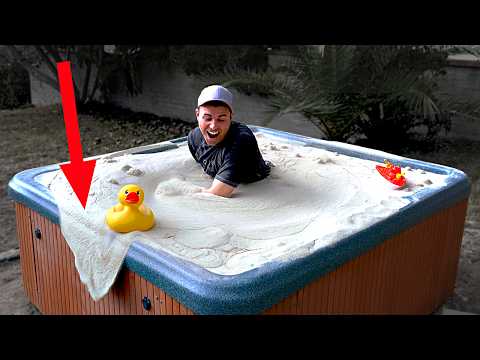
Liquid Sand Hot Tub- Fluidized air bed
About this video
Mark Rober builds a hot tub filled with sand fluidized by air blown from below, so that the sand behaves like a liquid. He explains how fluidized beds work and shows people swimming in them.
Why it appears in the archive
HN mentions it as the famous, kid-delighting demo of fluidization, especially in sand battery and industrial process threads.
AI-generated summary and labels from the source dataset; verify important details against the video. Source & credits.
From the Hacker News discussion
Faked and discovered to include fake reactions that were then removed, are different situations. Mark has been producing high quality educational and entertaining videos that encourage kids to get into science. I have personally watched kids go nuts over his Fluidized air bed experiments, and convince their parents to try it out. [VIDEO] It sucks there was fake content in there, but the device was real and the fake actions removed.
Read original comment ↗No in fact this is a bloody brilliant design: they turn it into a huge fluidized bed reactor and extract the heat with air! See this fun fluidized sand-filled jacuzzi if you're not grokking my too brief explanation: [VIDEO]
Read original comment ↗Looks like they've got some bad Funnel Flow in the hopper. Mass flow is probably the desired flow regime. Using a non-conical hopper is probably a better idea and would negate the vibration, which can fail. Typically only change the shape of the hopper in one direction at at time as you move down. This often leads to hoppers with an exit that is a slot and not round. We've used these powder consultants before and I took a week long course on hopper design: [LINK] Edit - another method we use to create empty-able hoppers: fluidization. Not sure if this fits with your processing strategy but it also mixes the powder somewhat which prevents size segregation of the particles. And this video is pretty cool: [VIDEO]
Read original comment ↗Let's guess. I'm going to say they are dissolving the 'precursors' into the co2, pumping it through the bed of particles with sufficient vigor to achieve 'fluidized' [1] state. As the supercritical co2 rises through the bed, the particles are dumping heat into it, ultimately flashing to vapor and leaving the solute (or at least the metallic part of it) behind as a thin film on the particle that did the trick. This of course leaves the particle itself cooler, making it less likely to receive additional deposition and resulting in a more uniform thickness across the batch. These coated particles are probably then going to be used as a catalyst in some other process. [1] [VIDEO] (alternate is that the the precursors themselves are the fluidized bed and the co2 is used to help move the coating from the donor to the recipient. If GP called them parts and not particles i would be more inclined to this option)
Read original comment ↗They probably use the trick where they blow air in the sand to give it "liquid" properties where they need the sand to flow. For those who haven't seen it there is a famous Mark Rober video: [VIDEO]
Read original comment ↗