 HackerTube.runGood videos, with context.
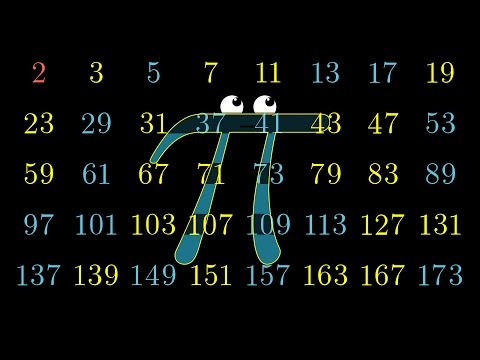
Pi hiding in prime regularities
About this video
3Blue1Brown shows how pi emerges from prime numbers via complex numbers and sums of squares, culminating in a formula for approximating pi.
Why it appears in the archive
Praised as a beautiful, understandable proof and a favorite among 3Blue1Brown videos.
AI-generated summary and labels from the source dataset; verify important details against the video. Source & credits.
From the Hacker News discussion
This is a really beautiful proof that connects complex numbers and primes to derive a formula for calculating pi. It should only require high-school algebra prereqs. [VIDEO] If you want to truly follow the proof, there's one little bit on the chi function in there which is connected to something called the One Sentence Proof. This looks rather esoteric and takes a bit of pondering to wrap your head around, but again only really requires high-school level algebra. Doing proofs like this is what math is really about. This is how you come to really understand. And this video also happens to be entertaining in how well-put-together it is.
Read original comment ↗3Blue1Brown has been recommended on HN before ( [LINK] ) But it's so great I think it bears bringing up in case anyone reading this comment has missed it. This channel animates math proofs, shows you the intuition behind fields of math, and constructs subjects in such a way as to make you feel like you could have invented them yourself. You'll still need a good textbook or something to go with the videos, but they cement the understanding in your mind very well and even open the door to more formal proofs. My favorite video is [VIDEO] . You'll have to take an additional step to get a complete proof (hint: read and work through the One Sentence Proof), but this is a beautiful piece of mathematics, shown in an understandable manner.
Read original comment ↗This is a half hour 3Blue1Brown video: [VIDEO] If you're willing to watch at least the first half of it, I think it'll give you a very intuitive grounding for 1) why integers have unique polynomial representations, and 2) why that's related to (semi)prime factorization.
Read original comment ↗