 HackerTube.runGood videos, with context.
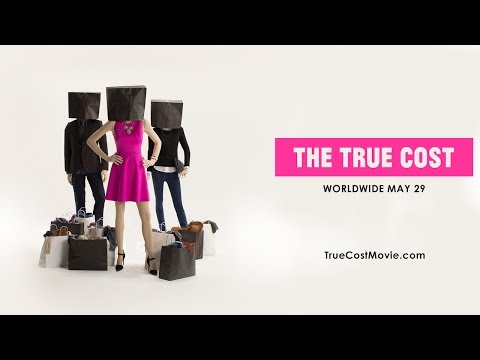
'The True Cost' - Official Trailer
About this video
The official trailer for The True Cost, a documentary on the fast fashion industry and who pays for cheap clothing. It touches on garment worker conditions and the Rana Plaza collapse.
Why it appears in the archive
HN cites the film as a source on fast fashion exploitation and pollution.
AI-generated summary and labels from the source dataset; verify important details against the video. Source & credits.
From the Hacker News discussion
The documentary The True Cost [VIDEO] covers many of the problems with fast fashion -- the pollution, exploitation, and more, but especially the pollution. I stopped shopping those stores since watching it. I recommend it.
Read original comment ↗> Must there always be an issue when the data doesn't suit a worldview? Why compromise a survey 's integrity with your own bias? Hello. Might I remind you of the Global North's historic and continued plundering of the Global South (developing countries)? Or should we forget about all of that? > It costs virtually $0 these days to start a SaaS company Yes, if you have a big cultural inheritance (which was itself plundered and stolen and appropriated from other countries). Oh yes, and you need a big trust fund and upper class parents, or at the least a pedagogical mentor who stimulates you, nourishes your curiosity. By saying this you are showing me the holy ground you are standing on. There are many hands who touch your life every day: feeding you, making your clothes, your electronics, etc. Check out the True Cost (2015): [VIDEO] , or 'Steve Jobs: The Man In The Machine': [LINK] Two key areas one can focus on: 1) imperial intellectual property machine - the work of Ruth Okediji is revealing with this: [LINK] and 2) Corporatist/institutionalized plundering since the colonial era: [LINK] Please would you consider these and try to understand their implications on today's reality?
Read original comment ↗> You could even argue that being "apolitical" actually means that your political opinion is that the status quo is acceptable I agree with this. I see Cultural Hegemony (domination-justification stories) being very strong in unexpected places. Family members or close friends who indirectly benefit from the artificial scarcity mechanisms (in SV especially Intellectual Property) that make up the various social class realities of rentier capitalism [1]. What seperates me and a mother of three in Bangladesh, who is getting paid starvation wages making the designer clothes I wear [2], is that I was lucky enough to have been born in the global North, in an upper-middle class family. I was able to grow up on the inside of the fort, and benefit from a rich inheritance [3]. [1] [LINK] [2] [VIDEO] [3] [LINK]
Read original comment ↗> pretend the positives don't exist Critiquing something is not denying positives. Please point out where I said that? That is not my intention. I would say that critiquing without providing an alternative is about sharing grief [1], than it is about discussing, planning and creating alternatives. I think you've given me the opportunity to reflect on my approach and message. I am for systemic evolution and integration: technology shapes us, and we shape technology, it's a spiral. Promoting intellectual property rights while at the same time talking about 'free markets' is one of the most harmful and backward Doublespeak going on in today's system I think. The systemic components and dynamics that are part of the intellectual property systems are ripe for evolution. I believe we are living with a pre-21st century systemic reality that doesn't account for the new opportunities available to us due to digital technology. The reality is that there is a world out there with people who are suffering at the bottom of the corporate pyramids (the Precariat, e.g. gig workers - who have no job security, no benefits, and not many prospects of a peaceful retirement). Then there are also the hundreds of millions suffering in so called 'developing' countries whose resources are plundered and whose governments compete for industrial-production contracts with our corporatocracy [2][3], creating continuous race-to-the-bottom dynamics that squash workers' rights and create environmental catastro
Read original comment ↗Noone in the elite wants to examine the exploitative capitalist relationships that support fast fashion The True Cost (2015) documentary trailer: [VIDEO]
Read original comment ↗> Of course in the modern world, calories are too cheap to meter. Our instincts no longer make sense. Maybe for intellectual laborers in the global north. Not for the starving billion who are barely surviving, yet are also producing all the commodities global north capitalists force them to make: often after having been forcefully bribed/expelled from their land, mostly by ruthless global north firms together with corrupt governments. [1] [LINK] [LINK] [VIDEO] [LINK] [1] [LINK]
Read original comment ↗> moving forward with a plan to block incoming sunlight could alter rainfall patterns and cause monsoon rains that millions of farmers in India rely on to dry up First, global north capitalist governments and firms force India (and other global south countries) to make their clothes, [1] their iPhones, [2] and more [3], for peanuts. Then they go and fuck up their food security. What a marvellous system. [1] [VIDEO] [2] [LINK] [3] [LINK] , [LINK]
Read original comment ↗> What did Nike do right? Luck and paying the right celebrities for endorsements? Also using sweatshops in the global south to extract superprofits [1]? More and more I'm starting see branding as a way for big companies to slowly condition people to relate emotionally to some spectacle [2] (e.g. an exciting celebrity spokesperson in an advert), distracting them from an often exploitative and unsustainable production process. How many people know about Rana Plaza? [3] It's exciting to see new initiatives like 'Fixing Fashion' though (Alicia Minnaard and Dave Hakkens)[4]. [1] [LINK] [2] [LINK] [3] [VIDEO] [4] [LINK] - short intro: [LINK]
Read original comment ↗