 HackerTube.runGood videos, with context.
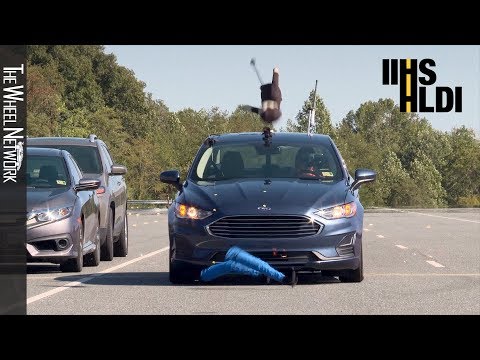
IIHS Pedestrian Autobrake Tests – Audi, Ford, Hyundai, Kia, Mercedes-Benz, Nissan, Subaru
About this video
Footage of IIHS tests of pedestrian automatic emergency braking on 16 midsize cars, with ratings from superior to basic or no credit.
Why it appears in the archive
HN references it as evidence that pedestrian-detecting emergency braking is routinely tested by independent agencies.
AI-generated summary and labels from the source dataset; verify important details against the video. Source & credits.
From the Hacker News discussion
The IIHS does all sorts of autonomous braking test scenarios involving pedestrians - [VIDEO] A pedestrian darting out from behind a car is known to be a tricky scenario, but some systems handle it at least some of the time. This scenario looked like the pedestrian was unobstructed and traveling in a predictable direction, so it’s pretty unnerving if it’s real. Long story short, even in Teslas, even just autonomous braking and crash avoidance is a great extra safety layer, but far from something that should be relied upon. Tesla is reckless for selling it as something that can be relied upon to successfully pilot a car.
Read original comment ↗There are some newer cars with AEB that have pedestrian detection, though. You can watch videos of IIHS testing those features [0]. It's not a perfect solution but will automatically brake if a collision with a pedestrian (or other VRU) is predicted and the driver is not braking. [0] [VIDEO]
Read original comment ↗These systems do work and have worked for years. They are also regularly tested by IIHS. See, for example: [VIDEO] And Teslas at least used to do this too: [LINK] If they no longer stop reliably to avoid hitting stationary objects, this is a serious problem that needs to be corrected.
Read original comment ↗Nearly every major manufacturer has a separate emergency stop system that continually looks for an obstacle in the vehicle's path and applies braking force, overriding the driver and any cruise control or self-driving that is in use. These often use RADAR, have worked for years, and are routinely tested by international agencies such as the IIHS. See, for example: [VIDEO] Teslas at least used to do this too: [LINK] [LINK] If Teslas no longer have this functionality, is a serious problem that needs to be corrected. That could mean reprogramming existing cameras or adding a sensor if the system really did rely on the now-removed RADAR.
Read original comment ↗