 HackerTube.runGood videos, with context.
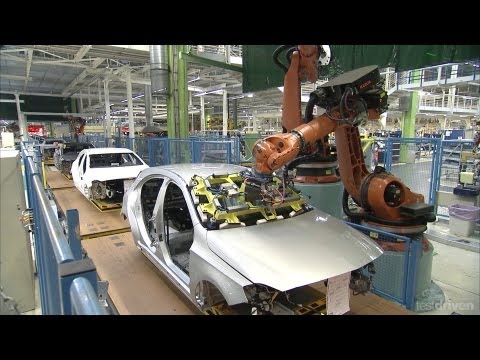
Mercedes A-Class Production line
About this video
Footage of the Mercedes A-Class production line at the Rastatt plant in Germany, filmed in 2013. It shows robots and fixtures working through assembly.
Why it appears in the archive
Used as a concrete example of modern car assembly, with short cycle times and heavy robotic automation, in manufacturing and automation threads.
AI-generated summary and labels from the source dataset; verify important details against the video. Source & credits.
From the Hacker News discussion
It's not unusual. Here's the Mercedes A-class assembly line.[1] Cycle time is about 40 seconds. That's 720 cars in an 8 hour shift. It's not unusual to run two shifts of production, and do maintenance on the third. In some highly automated plants, maintenance is in the daytime, and production is at night, with few people around. That's more for small parts than entire cars. Production line design and tuning is all about cycle time. The line runs at the speed of the slowest station. Any operation that takes too long has to be broken up into successive operations, even if one station could do it. You can fan out the line to multiple stations if you absolutely have to have a long cycle, but that adds cost, takes up floor space, and is really tough to retrofit. It's not unusual, though, to redesign the slowest station if that will speed up the whole line. Take a look at that Mercedes assembly line. Note all the custom fixtures required, many with sensor and actuators attached. All those have to be designed, built, tested, and run through enough cycles that they behave reliably. One failure stops the whole line. [1] [VIDEO]
Read original comment ↗I think it's likely that automation will be a huge creator of jobs. And I'm not talking about creation of high skill jobs at the expense of destruction of low skill jobs. I'm talking about a net creation of both low and high skill jobs. Allow me to explain. Here's a youtube movie of some robots in a Mercedes factory [VIDEO] There are thousands of movies like that. Lots of robots doing a lot of work, and apparently displacing lots of jobs. But there are some jobs in the background. Someone has programmed those robots. But aren't those programmers (super-)highly skilled? I don't know for sure, but it feels to me a robot is programed like an Excel macro: you record the moves, and then edit what you recorded. For an Excel macro, both parts are done (generally) by the same person, but for industrial robots, they are probably done by different people. The person who is being recorded needs only know how to manipulate a mechanical arm with a controller, that is probably not very different from a PS4 controller. The person who edits the macros, creates procedures, then combines them, optimizes them, creates tests, etc, etc, that person is a highly skilled individual. The other one not so much. The difference here is the capacity for abstraction. Now, one could say that both these jobs happen only once, and then the robot performs the jobs thousands of times, so you have 2 new jobs (one high skill, one low skill) displacing thousands others. Alas, the programming, maintenance, re-prog
Read original comment ↗> Except that the 10 million number does not matter if their entire system is set up to make exploding-fuel cars. The only thing common is the external shell and the dash electronics. The real expertise and resource is needed to make the rest of the stuff. And Tesla is ahead in that. It's all about logistics, infrastructure and capital. Have a look at this video: [VIDEO] Switching to batteries essentially just means reprogramming those robots. > Please point me to a battery factory this big, set up exclusively to supply batteries for one EV model. Please point me to a factory that actually produces 35GWh/a ;)
Read original comment ↗