 HackerTube.runGood videos, with context.
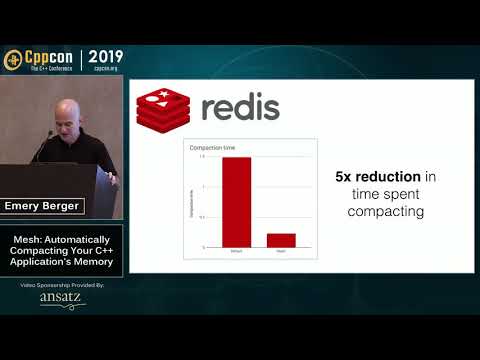
CppCon 2019: Emery Berger “Mesh: Automatically Compacting Your C++ Application's Memory”
About this video
Emery Berger's CppCon 2019 talk introducing Mesh, a drop-in malloc replacement that compacts memory in unmodified C and C++ programs. It tackles fragmentation by merging pages without changing pointers.
Why it appears in the archive
HN recommends Berger's talks as fascinating and cites Mesh as mind-blowing memory allocator work.
AI-generated summary and labels from the source dataset; verify important details against the video. Source & credits.
From the Hacker News discussion
"Performance matters" by Emery Berger on StrangeLoop'19 is a great talk - [LINK] Also, rest of his talks are also fascinating: - [VIDEO] - [LINK]
Read original comment ↗You’d need cooperation between your malloc implementation and the application code. It’s possible, but tricky. If your malloc returned a pointer to a pointer, and promised to keep the first level pointer up to date, and was able to lock your application whenever it moved things around, it could work. Someone else already mentioned, but garbage collected languages do actually do this. Because they’re fully in control of memory (the language exposes no raw pointers), they’re able to create the layer of indirection you’ve suggested and move things around as they please. I know at minimum the JVM does this. The term to search for is “heap compaction.” There’s also the weird and wonderful work of Emery Berger et al with their “Mesh” malloc implementation, which blows my mind: [VIDEO] .
Read original comment ↗According to the cppcon talk about Mesh [1] (an allocator that implement compaction for C++ programs), the overhead can be massive too (17% overhead measured on firefox, 50% on redis!) [1] [VIDEO]
Read original comment ↗