 HackerTube.runGood videos, with context.
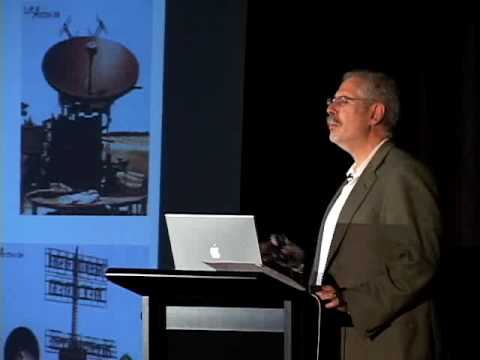
Secret History of Silicon Valley
About this video
Steve Blank's Computer History Museum lecture argues that Silicon Valley's roots lie in WWII radar and electronic warfare work, Stanford's Fred Terman and Cold War military funding rather than the semiconductor alone.
Why it appears in the archive
HN commenters call it a favorite introduction to Valley history and cite it whenever government and military funding of tech comes up.
AI-generated summary and labels from the source dataset; verify important details against the video. Source & credits.
From the Hacker News discussion
When I first moved here my favorite introduction to the valleys history was Steve Blanks The Secret History of Silicon Valley. It's well worth the hour [VIDEO]
Read original comment ↗You've gotta watch Steve Blank's "The Secret History of Silicon Valley". Goes back to its post-war roots in 40's and 50's. A real gem and quite surprising. [VIDEO]
Read original comment ↗I see a lot of comments addressed to "this guy" referring to Steve Blank. Let's not forget he's been involved in silicon valley startups since the 70s, including founding semiconductor companies. While they're no hello world rails startup, he has a proven track record and a first-hand experience of how the valley has evolved. I suspect many of you haven't seen his take on the history of the valley, which might give context to his views. [VIDEO]
Read original comment ↗Related thread: `Ask HN: What's the best book on the early history of the Internet and/or Web?` [LINK] My previous reco: Not a book, but a great video via Steve Blank: [VIDEO] Also `Bret Victor The Future of Programming`, which is misleading as above is performance piece where title slide reads `1973` [LINK]
Read original comment ↗Yes, Silicon Valley grew out of quite sophisticated WW2 military R&D, so quite similar to USSR actually. I like this talk given at the Computer History Museum about the history of Silicon Valley, which was secret for many years: [VIDEO] You can argue USSR lacked followup demand for computing from outside the military, and that this was caused by organizational issues. It’s probably pretty important to also state the relative wealth disparity at the start of the relevant period, from 1940 onwards, say. Russia was basically feudal in 1910, and it would be hard for advancement to catch up to US levels by 1940 no matter the organization of the economy, and then we have to account for the devastation of WW2 which followed (WW2 was expensive for US, but it didn’t lose industrial capacity except via opportunity cost). I don’t say this as any kind of apologia, but think it makes more sense to compare USSR to less developed countries than US — where it still doesn’t compare favorably in many ways, but it’s far more interesting and debatable.
Read original comment ↗I'm sure there are lots of reading options but this is a very good presentation on the topic (of Silicon Valley and Stanford). [VIDEO]
Read original comment ↗He has a good frame of reference: “I see this as an opportunity for academics in New York to contribute to start-up culture,” says Wiggins, referring to the pivotal role that Stanford’s dean of engineering, Frederick Terman, played in the rise of Silicon Valley. Stanford is what it is today thanks to Terman's meddling and the army ( [VIDEO] ). If Wiggins is NYC's Terman, what's NYC's army equivalent?
Read original comment ↗A California subtlety often missed by those who didn't grow up here (and many that did) is the fact that Silicon Valley started out a lot like the other 'the valley' that grew up with the aerospace / defense industry, the San Fernando Valley, which have extensive similarities, including small details like the Fry's electronics and bigger details like the main drags through town. Ventura Blvd. and 82 are basically the same El Camino Real. The 101 (which parallels Ventura Blvd for quite a distance) is marked as El Camino Real, as is 82 in Silicon Valley. Both have foundations in the Spanish missionary trail. They're basically two sections of one very long road. If you've seen Steve Blank's presentation on the 'secret history' of Silicon Valley you'll see where I draw the parallels. Lockheed Martin, Rocketdyne, General Dynamics, Litton, Rockwell, and many others were once based there. [VIDEO] But the divergence was inevitable I suppose - the valley up north has gotten comparatively nicer in the past 15 years, though, as San Fernando's fortunes have faded a bit. The SF valley now basically lacks a coherent high technology business base and all the aerospace and defense has moved out. It's been replaced by Hollywood entertainment, healthcare, porno, import/export, and a bunch of other smaller industries and some light manufacturing. It's not defunct in any way - it's still pretty nice, but it's just not as nice as up north. Most of the newer wealth is in other areas of LA. Both ar
Read original comment ↗