 HackerTube.runGood videos, with context.
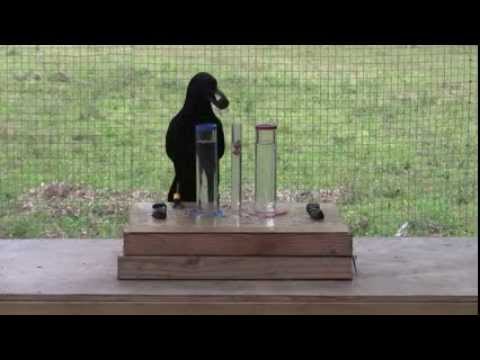
Causal understanding of water displacement by a crow
About this video
A silent PLOS ONE video of New Caledonian crows solving Aesop's Fable puzzles by dropping objects to raise water and reach food. It shows example trials from experiments testing causal understanding of water displacement.
Why it appears in the archive
Used as vivid evidence of crow intelligence and animal physical reasoning in discussions of cognition.
AI-generated summary and labels from the source dataset; verify important details against the video. Source & credits.
From the Hacker News discussion
The reasoning ability and executive function of birds, crows in particular, is astonishing. Intelligence (certain kinds, at least) may be just as reliant on brain:body mass ratio as it is on overall brain size and complexity. [LINK] [VIDEO]
Read original comment ↗Crows are astoundingly intelligent. If you're having a slow day, a quick youtube of "crows solving puzzles" yields some great videos of them solving complicated tasks like water displacement to reach food[0]. I believe raccoons share this achievement. Additionally, there was a thread on here some time ago[1] by a Dutch Startup[2] about trying to teach crows to exchange cigarette butts for treats inside a tiny device place in parks, I always thought that was a funny idea if you could get the crows to teach one another. [0] [VIDEO] [1] [LINK] [2] [LINK]
Read original comment ↗This video is a startling verification.of the crows mental capabilities. “Causal understanding of water displacement by a crow” [VIDEO]
Read original comment ↗When you formulate it so, the problem is the question itself, as, except if we are religious believers, we don't have any reason to consider a "soul" (or a "consciousness") to be a "nonphysical entity." Look at the etymology of the "psyche:" it's "the breath." At the time people explained their environment unscientifically they considered that the existence of "breath" makes the difference between the dead and the living person but also between the conscious and the unconscious bodies. Animals do breathe too. But humans saw themselves as "special" in their religious setup. As a kid would ask "does my dog go to heaven too when he dies?" See, we go deeper and deeper in religious explanations which just postulate something non-existing (once you accept nonphysical soul, it's easier to believe in heaven or reincarnation or whatever). Now go back and ask, if you believe that the only thing we can "see" around us that doesn't have the "physical entity" is the "soul" of humans why do you do so? Are humans by any way "the chosen ones" in the animal world, looking at their physical bodies and the processes in them? The scientific view doesn't see them so. The human "consciousness" is, so observed, more complex than the "consciousness" of the crow on the lawn due to the more complex brain, but both of these can be explained as the function of their physical "hardware" (the body and the brain) and the interaction with the environment. The "consciousness" as a "neurological process by wh
Read original comment ↗Some animals clearly show understanding up to a level [VIDEO] But they can not explain it to us, so "can explain" is a unnecessary high bar.
Read original comment ↗> I read somewhere about training crows to pickup cigarette butts in exchange food. I’ve always wondered if it would be possible to train a crow to pick up loose coins for food. Probably not. It probably seems like I'm shilling this researcher's blog in this thread at this point but this commentary [1] gives a short explanation of why. One of my hobbies is actually bird watching, particularly with crows. I love the animals, they're very fascinating creatures. I've had the opportunity to interact with many of them because I set out peanuts for them near my neighborhood. They've very gradually become acclimated to this routine, and they reliably arrive to pick up food if I make a particular noise and they're in the area. But I'm very skeptical that I could "train" them to start exchanging items for food. In captivity a crow's intelligence can be especially fostered and trained because there's no other source of food to distract it. If you want it to proceed through a puzzle [2] to get food it has to do so. But wild crows are very, very cautious and (like most animals) very economically rational in their feeding habits. To date none of the wild crows who give people items have been trained to do so, it's been a happy accident (it's never happened to me, unfortunately). If you start imposing an exchange system on the food dispensary, you might find that the crows simply go elsewhere for easier meals. _____________ 1. I read somewhere about training crows to pickup cigarette butts
Read original comment ↗It's a very interesting question. I guess big apes can, but I have no proof at all. Also, the extension of the question to the ice-water transition in the other comment is interesting too. Anyway, the first thing that came to me mind was " Causal understanding of water displacement by a crow " [VIDEO]
Read original comment ↗I wouldn't say that human brain is that efficient (per volume). Compare and contrast with the brain of rats or Corvidae: [VIDEO] .
Read original comment ↗