 HackerTube.runGood videos, with context.
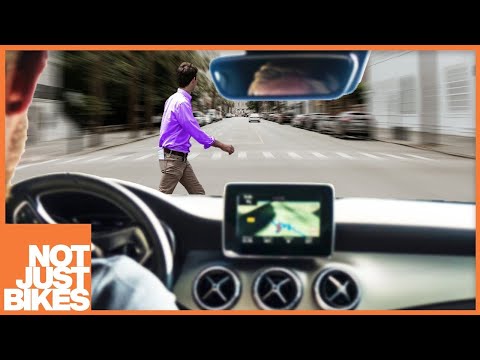
Crossing the Street Shouldn't Be Deadly (but it is)
About this video
Not Just Bikes explains why crossing streets is dangerous in the US and Canada, where roads are designed to move cars fast, and contrasts it with Dutch designs for pedestrians.
Why it appears in the archive
Linked in road-safety threads as a good explanation of how street and signal design prevent pedestrian deaths.
AI-generated summary and labels from the source dataset; verify important details against the video. Source & credits.
From the Hacker News discussion
You're looking for fault and there's something to that but there's also just re-designing the streets to prevent the accidents in the first place [VIDEO] also [LINK]
Read original comment ↗I'm not talking about markings, I'm talking about designing crossings so that pedestrians and cyclist don't have to watch out for turning cars and improving traffic lights so that pedestrians and cyclist don't feel the need to run red lights. Here are two really good videos about this that talk about this: - [VIDEO] - [LINK]
Read original comment ↗Only tangentially related but .... In California, a double white line is supposed to mean "don't cross period" [LINK] . > (b) If double parallel solid white lines are in place, a person driving a vehicle shall not cross any part of those double solid white lines, except as permitted in this section or Section 21655.8. > (d) The markings as specified in subdivision (a), (b), or (c) do not prohibit a driver from crossing the marking if (1) turning to the left at an intersection or into or out of a driveway or private road, or (2) making a U-turn under the rules governing that turn, and the markings shall be disregarded when authorized signs have been erected designating offcenter traffic lanes as permitted pursuant to Section 21657. [LINK] > (a) Except as required under subdivision (b), when exclusive or preferential use lanes for high-occupancy vehicles are established pursuant to Section 21655.5 and double parallel solid lines are in place to the right thereof, no person driving a vehicle may cross over these double lines to enter into or exit from the exclusive or preferential use lanes, and entrance or exit may be made only in areas designated for these purposes or where a single broken line is in place to the right of the exclusive or preferential use lanes. > (b) Upon the approach of an authorized emergency vehicle displaying a red light or siren, as specified in Section 21806, a person driving a vehicle in an exclusive or preferential use lane shall exit that lane immedi
Read original comment ↗Not Just Bikes did a video about the timing/switching algorithm of European traffic lights recently: [VIDEO] They look amazing. Wish we had them here in the US.
Read original comment ↗Not Just Bikes on YouTube covers road/pedestrian/bike safety extensively. [LINK] Specific videos: Crossing the street should be safer: [VIDEO] How to quickly build a cycling city: [LINK] Wasting money on car infrastructure: [LINK] The wrong way to set speed limits: [LINK] Safe cycling: [LINK] "Stroads" are dangerous: [LINK]
Read original comment ↗See the youtube channel Not Just Bikes[1], specifically videos like - "Why the Dutch wait less at traffic lights" - [LINK] argues that American traffic engineering is optimised for car movement, at the expense of pedestrians and bikes, whereas Dutch traffic engineering is to minimise conflict between vehicles and maximise movement of people overall. Leading to more complex but more efficient intersections. - "The Dutch solution for safer sidewalks - continuous sidewalks" - [LINK] has crossings at junctions where cars and people intersect designed so the cars visibly have to travel over the sidewalk through the people's area, instead of designed so the people have to visibly travel over the road, through the car's area. - "Crossing the street shouldn't be dangerous, but it is" [in North America] - [VIDEO] talking about length of crossings on wide road, traffic signals, priorities, etc. [1] [LINK]
Read original comment ↗The best example is that even your curious question comes with a car-minded implicit assumption that it's the pedestrian who is crossing, not the car. In a pedestrian-centric design, cars are the ones who cross. See [VIDEO] .
Read original comment ↗