 HackerTube.runGood videos, with context.
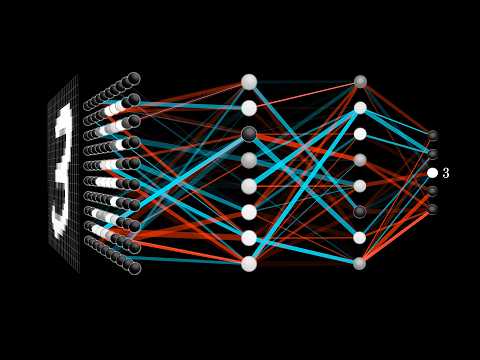
Neural networks explained, without a coding setup
HackerTube viewing guide · Source-checked November 2, 2026
Before you press Play
Choose this first if the layer diagrams themselves are unfamiliar. Its digit-recognition example gives the symbols something concrete to refer to before you meet gradients in code.
This is a conceptual orientation, not a build-along. Choose micrograd when you can already describe a layer and want to implement differentiation.
Work toward these outcomes
- Describe inputs, hidden layers and outputs using handwritten digits as the example.
- Distinguish a neuron’s activation from its learned weights and bias.
- Connect the layer picture to matrix notation, then recognize that training is a separate question.
Bring these foundations
- Comfort with basic arithmetic and graphs.
- Vectors and matrices help with the notation section; no Python setup is needed for this video.
A useful readiness check
Explain what changes when a weight changes, and what the output layer is trying to represent. If those are still vague, revisit the written lesson before moving to code.
Neural networks explained: creator chapters
Selected landmarks from the creator’s chapter list (18:40 total). Choose a timestamp to load the YouTube player at that point; without JavaScript, the link opens YouTube.
- 2:42What are neurons?
- 3:35Introducing layers
- 8:38Edge detection example
- 11:34Counting weights and biases
- 13:26Notation and linear algebra
- 17:03ReLU vs Sigmoid
See every chapter in the creator’s description
Creator corrections to keep beside the video
- The creator notes a notation correction at 14:45: the final bias-vector index should be k.
Original course files and resources
Next in your learning path
About this video
3Blue1Brown's first chapter on deep learning explains what neurons and layers are and the math underlying a basic neural network, using handwritten digit recognition with visual animations.
Why it appears in the archive
HN treats it as the standard first stop for learning neural networks, praised for making the math intuitive.
AI-generated summary and labels from the source dataset; verify important details against the video. Source & credits.
From the Hacker News discussion
I'm in the same boat. For long time, I was interested in AI but at the same time intimidated by math. I'm relatively comfortable with discrete mathematics and classical algorithms and at the same time calculus and linear algebra is completely foreign to me. Also, I do not accept way to learn ML without good understanding of core principles behind it. So math is a must. A few months ago, I stumbled upon very amazing YouTube Channel 3Blue1Brown which explains math in very accessible way and at the same time I got feeling that I finally started understanding core ideas behind linear algebra and calculus. Just recently he published 4 videos about deep neural networks: [VIDEO] [LINK] [LINK] [LINK] So my fear of ML was gone away and I'm very excited to explore whole new world for neural networks and other things like support vector machines etc
Read original comment ↗[VIDEO] 3Blue1Brown’s playlist on neural networks. Like other 3Blue1Brown videos, the visualisations and explanations of the math/concepts are so amazing, they give you the intuition behind the neural networks naturally.
Read original comment ↗3blue1brown videos are probably the best equivalent. Maybe a little basic? But really, all his math videos are just ridiculously good quality. [VIDEO]
Read original comment ↗Essentially a computer neural network is just a lot of addition (and matrix multiplication) of floating point numbers. The parameters are the "strength" or "weights" of the connections between neurons on different layers and the "bias" of each neuron. If neuron Alice is connected to neuron Bob and Alice has a value of 0.7, and the weight of Alice's connection to bob is 0.5, then the value sent from Alice to Bob is 0.35. This value (and the values from all the other incoming connections) are summed at added to the neuron's negative bias. I highly recommend checking out 3blue1brown series on how neural nets, gradient descent, and the dot product (implemented as a matrix multiplication) all tie together: [VIDEO]
Read original comment ↗For me 3brown1blue series: [VIDEO] was an excellent introduction that made Andrej's videos understandable. Then I did 3 first chapters of fastai book, but found it too high level, while I was interested in how things works under the hood. Going through Andrej's makemore tutorials required quite a lot of time but it's definitely worth it. I used free tier of Google Colab until the last one. Pausing the video a lot after he explains what he plans to do and trying to do it by myself was a very rewarding way to learn, with a lot of "aha" moments.
Read original comment ↗3blue1brown is currently doing a terrific series on how neural networks work, which nicely compliments this blog post. [VIDEO]
Read original comment ↗This was very timely for me and for anyone else learning, here are the first few videos of the series: [VIDEO] [LINK] [LINK] (Original video) [LINK]
Read original comment ↗The Stanford course is pretty good. [LINK] For something quicker & less applied, maybe the 3b1b series on neural networks: [VIDEO]
Read original comment ↗