 HackerTube.runGood videos, with context.
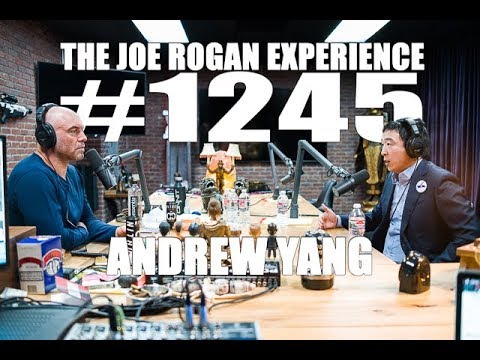
Joe Rogan Experience #1245 - Andrew Yang
About this video
Joe Rogan's long interview with Andrew Yang during his 2020 presidential run. They discuss universal basic income, automation and his policy proposals.
Why it appears in the archive
Suggested as a starting point for understanding Yang's capitalist case for UBI, though some note it is long and dated.
AI-generated summary and labels from the source dataset; verify important details against the video. Source & credits.
From the Hacker News discussion
I was listening to Presidential candidate Andrew Yang in his podcast with Joe Rogan. His plans, since there's a lot of avoidance, is to attempt a different route called a "value added" tax where there's a tax for trucking mileage and online transactions. He mentioned other countries to both of these, but don't remember which he mentioned off the top of my head. Here's the podcast for those interested, there's a lot of other interesting discussions here that are related to this topic, such as automation and basic income. [VIDEO]
Read original comment ↗This might be good point to mention the only 2020 presidential candidate who is talking about how UBI could address this seemingly inevitable future that is closer than we think. Andrew Yang. See his discussion with students at Georgetown Univ. [LINK] or for a longer exposition of his ideas see [VIDEO]
Read original comment ↗That is candidate Andrew Yang's proposal. 120K to every American over 10 years. You should checkout his proposals. There are long form interviews on Youtube. [VIDEO]
Read original comment ↗A public jobs/infrastructure program would work something like this: various states would lobby for money to spend in their states, $billions in large contracts would be awarded to politically connected corporations that would bill at $100/hr keep a large percentage and subcontract the work at $40/hr to smaller businesses that in turn would keep a percentage and hire people to do the work for $15/hr. That is trickle down economics. If instead you distributed the $billions to every citizen in the country, the vast majority of the money would be spent in local economies on things like day care, car or home repair, taking your kids in for dental cleaning. That is a trickle up economy. I too reasoned that UBI was liberal social nonsense. But I've been following Andrew Yang's presidential campaign and his justifications make sense from a capitalist point of view. As Yang points out - this is capitalism that doesn't start at zero. It has benefits. Check out his long interviews on Youtube. The Joe Rogan interview is a good place to start [VIDEO] . If you don't have the time check out his talk with the AARP [LINK] or the AFL-CIO [LINK]
Read original comment ↗It was a poor joke making a critique of the Medium post. > It does make me more interested in hearing what Yang has to say because it seems honest and like a statement from someone who hasn't been doing political activism for years. Lots of people suggest the Joe Rogan podcast [0], but that is old, things have changed in his campaign, and it is long. I rather like the Now This interview [1] (30 mins). Others like the Iowa Town Hall[2] (hour). The reasons I personally like Yang are #1, climate (I'm a scientist myself and work in labs with many climate scientists. I don't think his plan is going to solve everything, but I like it more than the other candidates. It is clear to me he has talked to experts), #2 I think he's trying to answer an important question that I've been curious about for a long time "How do we transition into a post scarcity society". Or specifically "how do you transition into an economy where you do not need a large number of workers. What do you do if 10% of your population is unemployable, not because of lack of skills, but because lack of demand?" It is the reason I am interested in UBI in the first place (where I've read a lot about here on HN). So I rather like his talk about changing the rules of the economy and making them human-centric. I do personally see a drastically changing economy and society, and I think he is asking the right questions about it. I have also seen him change positions after talking to experts, which I think is an essential q
Read original comment ↗