 HackerTube.runGood videos, with context.
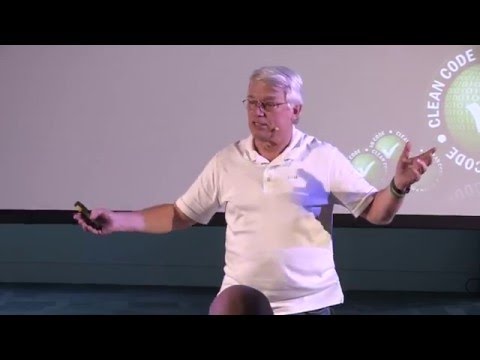
"Uncle" Bob Martin - "The Future of Programming"
About this video
Robert C. Martin (Uncle Bob) traces the history of software from 1948 to today, looking at the problems programmers faced, how they were solved, and what mistakes the profession made. He then projects where the field is going, including professionalism and regulation.
Why it appears in the archive
HN recommends it as an engaging overview of programming history and an argument for professional standards, citing the agile manifesto section and the claim that software has advanced little since the 1950s.
AI-generated summary and labels from the source dataset; verify important details against the video. Source & credits.
From the Hacker News discussion
For an informed answer you can see: "Uncle" Bob Martin - "The Future of Programming" [VIDEO] Please, see the video. It is an awesome informative and it will give you a lot of insight on our current situation. It is not about startups, but about the maturity of the industry itself.
Read original comment ↗Bob Martin has a great talk [VIDEO] , which illustrates a lot of history of computers. He asserts that the number of devs is doubling every 5 years which means that half the developers have < 5 years experience. The industry has lots much of its scientific discipline which has to return, or regulations will force more structure. Anyway he's a great speaker and this is one of my favorites.
Read original comment ↗For those interested in the history of computer programming, "Uncle" Bob Martin gave an excellent talk in 2016 called "The Future of Programming", starting with Alan Turing in 1936. It's a fascinating introduction to the evolution of hardware and programming languages. I was particularly amazed at how Turing used CRT screens for memory and output. The history discussion starts at around 11 min: [VIDEO]
Read original comment ↗I am not working in industry; I'm such a loner programmer that I struggle in industry. But since my wife likes her work, I have space to write the software I want to write. My first goal is to make that software good enough and useful enough to create an engineering-only company like Hwaci, the company that does SQLite and Fossil. If I succeed at that, I'll see about trying to pull in enough money to retire early and do charity work through my church. But I have another goal for while I'm still in industry. I want to change our industry such that it is a professional industry, with a code of ethics, to where we create software that serves users , not our employers or government. This means fighting against slurping up user data, serving ads, and other ways that software disobeys users in favor of obeying its creators. I even created a Twitter account to show some of those things. [1] Yes, that means an uphill battle against basically all of Big Tech, and I don't expect to win. But if I make people think about it, I'll take that as a win. But regardless, I feel strongly about it because users depend on us to make software that will serve them. If we don't, no one will. Uncle Bob Martin talked about this. [2] (That link starts at a good point, but the whole talk is worth watching.) So that's my goal: make good software and change the industry for the better. Lofty, yes, but I'll be satisfied by completing one of those goals. [1]: [LINK] [2]: [VIDEO]
Read original comment ↗Really good talk! This is a newer and also really good talk about programming languages and their future: "Uncle" Bob Martin - "The Future of Programming" [VIDEO]
Read original comment ↗To me, the real issue is that the managers got ahold of agile. Most managers just want waterfall, I'm convinced, which I suspect is where so much of the head scratching about Agile comes from. We developers have done an abysmal job developing, socializing, and formalizing our standards and practices. Needing to keep agile things loose because teams and industries and people and projects differ is one thing. But, we don't even try to establish unambiguous definitions for general topics like test-driven development, big visible charts, or sprints. Frankly, we need industry leadership and earned certifications for developer craftsmanship. Uncle Bob recently has shared some good food for thought in this area. Not only does he recommend the direction we professional devs need to head, but he also speculates as to what will happen if we don't (loss of freedom.) [VIDEO]
Read original comment ↗Rich Hickey - "simple made easy" [LINK] Rob Pike - "concurrency is not parallelism" [LINK] Uncle Bob Martin - "future of programming" [VIDEO] Martin Kleppmann - "transactions: myths, surprises and opportunities" [LINK] Simon Brown - "software architecture vs code" [LINK]
Read original comment ↗Let me tell one thing: I absolutely hate sloppy engineering. And by sloppy I also mean rushing. There is a class of engineers and engineering managers who think that they are rockstars because they can churn out code quickly. I am absolutely disgusted and sick of this attitude. And why do I bring it up here? Because I suspect this kind of attitude was partly blamed for this fatal and tragic accident. Of course this is pure speculation. But my 12 years experience in the software industry makes me believe that's what happened. Also a relevant talk by Uncle Bob: [VIDEO]
Read original comment ↗