 HackerTube.runGood videos, with context.
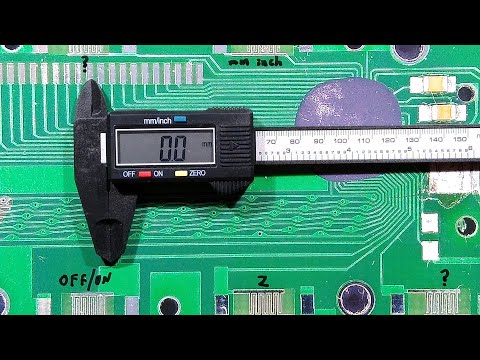
Inside a cheap set of eBay digital calipers
About this video
Big Clive tears down a cheap eBay digital caliper, explaining its capacitive linear encoder and measuring its quiescent current. He finds it surprisingly accurate and repeatable for its price.
Why it appears in the archive
Cited in caliper threads as a teardown showing how cheap digital calipers work and that they are better than expected.
AI-generated summary and labels from the source dataset; verify important details against the video. Source & credits.
From the Hacker News discussion
That's interesting. Big Clive explored a set of inexpensive calipers that seemed to work on an interference pattern but sensed with two PCBs passing over each other. He mentions in his theory of operation moire pattern measuring devices. It's a fascinating device. [VIDEO]
Read original comment ↗You can buy cheap digital calipers for just £5 on ebay these days. Big Clive did a tear down of some that he found and found they were pretty good except for the fact that the digital circuit drains the battery even when it's off: [VIDEO]
Read original comment ↗Teardown of cheap calipers: [VIDEO] Power consumption analysis: [LINK] > The Mitutoyo caliper draws about 1/4 the power of the chinese caliper when on, and about 1/8 the power when off. SR44 batteries should last longer than LR44. For infrequently used cheap calipers, one workaround for short battery life is to remove the battery between uses, [LINK] > cheap calipers never actually turn off.. because the encoder they use is not an "absolute" encoder. You push the caliper all the way to the closed position, push "zero", and then the circuitry simply counts the number of pulses that goes by and figures out how far the caliper moved. If the caliper fully turned off, it would lose its position and you'd have to re-zero it every time you turned it on. > Mitutoyo Digimatics have what they call an "absolute encoder". The sensor doesn't just count the number of pulses. They've put a special reference pattern on their encoder such that the caliper's circuitry can figure out where it is at any given time. With a Mitutoyo caliper, you can turn it off, take the battery out, slide it to a new position, put the battery back in, turn it on, and it will know exactly where it is. This "absolute encoder" allows the caliper to fully shut down when not in use, greatly increasing battery life. Hacking a switch onto cheap calipers, [LINK] & [LINK] & [LINK]
Read original comment ↗Big Clive also covered this a couple years later. Has more of an emphasis on the teardown and schematic. The comments are also great for links to other people's findings. This article is great for more details about how the electrons move. [VIDEO] I'd like to adapt the concept using flexible pcbs to make a largish Nest-style rotary encoder. To understand Vernier measurement conceptually, the Wikipedia article is actually not bad: [LINK]
Read original comment ↗Haven't looked into this deeply, but isn't this basically a vernier pattern printed into a hologram? How would this be better for mass manufacture compared to a vernier pattern capacitive encoder as seen in cheap calipers such as [1] ? I'm pretty sure photodetectors would be more expensive than capacitive sensors. AFAIK these are also based on an expired patent which i believe to be US4743902 [2], that was mainly used by Mitutoyo. [1] [VIDEO] [2] [LINK]
Read original comment ↗