 HackerTube.runGood videos, with context.
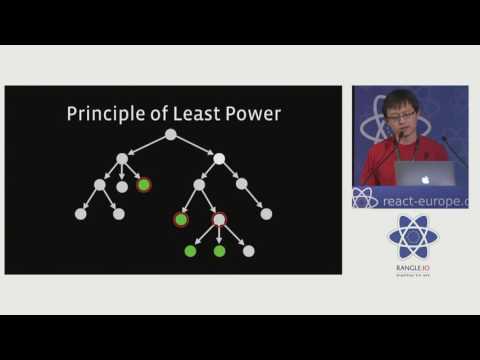
Cheng Lou - On the Spectrum of Abstraction at react-europe 2016
About this video
Cheng Lou's react-europe 2016 talk lays out a mental framework for thinking about abstraction levels in JavaScript tooling, from Angular and Grunt to Webpack and React. It uses that framework to reason about the cost of abstractions and how to choose between competing solutions.
Why it appears in the archive
HN points to it as thought-provoking material on the tradeoffs and costs of abstraction, especially in frontend tooling debates.
AI-generated summary and labels from the source dataset; verify important details against the video. Source & credits.
From the Hacker News discussion
This talk is incredible food for thought: On the spectrum of abstraction by Cheng Lou (react-europe 2016) [1] If you've read some of the classics, such as Structure and Interpretation of Computer Programs (1979, Gerald Jay Sussman and Hal Abelson) [2], this talk is a really interesting look at the state of affairs on abstraction circa 2016. [1]: [VIDEO] [2]: [LINK]
Read original comment ↗For a more visual explanation of the "cost of abstractions" watch this presentation by Cheng Lou (Facebook). [VIDEO]
Read original comment ↗The spectrum of abstraction: [VIDEO] This is an high level talk. it guides on how to choose between competing solutions to a problem when the commonly accepted answer is "it depends"
Read original comment ↗React is more like 'Lambda the Ultimate Web Component'. A component is almost a function returns element. Expanding a component is like calling a function and give it the property. So you can have some abstract common behavior in HOC f and g, then you can have HOC `h = compose(f(g))`. A quick comparison with Angular: @Component({template, style}) seems composable if we stretch a lot. But why make template and style in the decorator... They are not something we consider most abstract at all. The function is the simplest yet composable abstraction over the template, Cheng Lou also has a really excellent talk on the topic: [VIDEO]
Read original comment ↗I know, this isn't a novel concept. There was a good talk about the spectrum of abstractions and the tradeoffs of template languages vs React's approach at React Europe a couple of years ago (in fact, he goes into that this means there are some optimizations that are simply unavailable to React): [VIDEO] The question isn't whether DSLs or "just JS" are more powerful, the question is which tradeoffs they represent and which tradeoffs you prefer. It seems that HTMX is primarily based in the Python ecosystem and as a former Pythonista I see the advantage of having a DSL over having to write JS, especially that the former is much narrower, which is what you want in this situation.
Read original comment ↗Interesting that you should mention it. This talk [VIDEO] mentions some arguments why a DSL would not be a good approach for frontend/JS build tools. Namely that a DSL isn't adequate if the underlying best practices or requirements change a lot. That's why operating at a higher level of abstraction (function chaining/piping/composition) would make more sense. Now... that doesn't really favor Webpack. And I still don't quite understand why that tool is so popular.
Read original comment ↗