 HackerTube.runGood videos, with context.
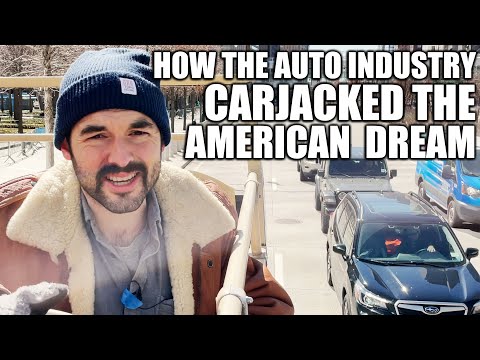
How The Auto Industry Carjacked The American Dream | Climate Town
About this video
A Climate Town video on how the auto industry reshaped American cities and culture through advertising, lobbying and campaigns like the 1939 World's Fair. It is snarky in tone but backed by a published source document.
Why it appears in the archive
Recommended in urbanism threads as a well-sourced account of how car dependency was manufactured.
AI-generated summary and labels from the source dataset; verify important details against the video. Source & credits.
From the Hacker News discussion
I have the same feeling, like we were slowly indoctrinated into believing that upvoting is the only thing we can do and participation is worthless. I recently watched this video[0] that shows how public perception over cars has been influenced over many many years into what we now have (and we now perceive as normal). I feel like it's somewhat related. [0]: [VIDEO]
Read original comment ↗There are quite a few factors, I'd encourage checking out the following videos by Not Just Bikes and Climate Towns that cover a broad range of city planning and zoning in the US. Strong Towns Play List by Not Just Bikes (This heavily covers city planning issues in the US): [LINK] The Suburbs Are Bleeding America Dry by Climate Towns (This covers zoning): [LINK] How The Auto Industry Carjacked The American Dream (This covers the auto industries impact on US cities.): [VIDEO] Dutch Cities are Better for the Climate (and my sanity) by Not Just Bikes (Not super relevant to zoning, but it's part 1 of The Suburbs Are Bleeding America Dry so I figured I'd link it.): [LINK] These are pretty snarky, but fun videos and the authors list their sources. Their video descriptions are worth checking out just to find a ton of reading material on each topic.
Read original comment ↗> America got to be car-centric not because of nefarious car companies or other special interests, it got to be car-centric because cars work very well for our use case Orr it could actually be that they paid for advertisements and politicians just to do that. If you don't want to read about it, here's a video that explains it: [VIDEO]
Read original comment ↗This depends on how you define ROI. Car infrastructure and lack of density reduces tax revenue for cities and strains infrastructure. There are other human benefits to reducing car traffic and use in favor of public transportation: * Reduces air pollution * Noise pollution * Allows a focus on human centric urban planning * Allows for higher density commercial and residential increasing tax revenue * Reduces pedestrian traffic injury Well done video essays: Parking minimums [LINK] Noise pollution [LINK] Infrastructure strain [LINK] More on Infrastructure and Sprawl [LINK] Articles: [LINK] [LINK] [LINK] Climate town videos are all well researched and provide an enormous amount of follow-up content from their sources. Generally, I care about all of the above and I perceive investments in public transportation to have a higher ROI. Some extra historical context is helpful too: [VIDEO] The book The Color of Law by Rothstein is worth a read. In the end there is a balance between public transportation and car dependency and right now the scales are leaning too much in favor of cars.
Read original comment ↗Well, one major player on shaping the streets was the emerging car industry itself. Not the only factor of course but nevertheless a very interesting story [0] to tell from that perspective where pedestrians not obeying the new strict rules began to be called jaywalkers. [0] [VIDEO]
Read original comment ↗"Aren't those laws being lobbied by corporations who only fund the politicians that promise to keep things in their favor?" [VIDEO]
Read original comment ↗> Most American cities are built on a scale designed around human driving. That's absolutely not true. It only became true in the post-war when there was a push for suburban sprawl, lobbied by GM and all the auto industry [0] > it's pretty safe to bet that she doesn't think that she can live where she does without a car. "Where there is a will, there is a way", right? The discussion is not even if she can go by without a car, but whether she would want it. > We can't even manage the political will to build enough housing to keep people off the streets. Ok, but then don't go around trying to rationalize your bad choices and poor capacity for civic organization. [1] Don't go around saying "I lived in NYC and I thought I could live without a car, but after I had kids I realized they are not so bad", and please don't go around saying "it can't be done". Amsterdam and Rotterdam were once also car-centric cities which managed to turn themselves around in less than a generation. There is no inherit limitation in the US that forbids this change to happen. There is no amount of American Exceptionalism that can prevent people from clamoring change. Maybe it won't be done in the US, because people are lazy and not willing to sacrifice their own convenience for some communal benefit, but it's super annoying to always get in these discussions when people try to hide their preferences on external circumstances. North American cities are they way they are by choice . [0]: How The Auto Indus
Read original comment ↗