 HackerTube.runGood videos, with context.
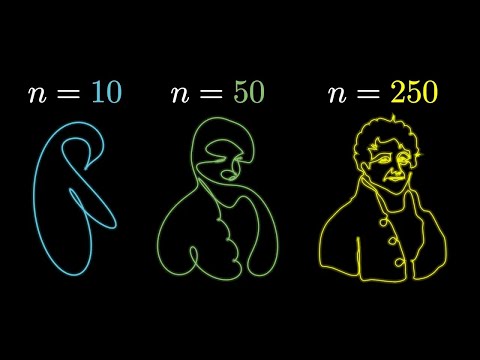
But what is a Fourier series? From heat flow to drawing with circles | DE4
About this video
3Blue1Brown introduces Fourier series, from the heat equation to drawing arbitrary shapes with rotating circles. It builds a visual intuition for decomposing functions into sine waves.
Why it appears in the archive
Recommended as the visual explanation that makes Fourier series and transforms click, even for laypeople.
AI-generated summary and labels from the source dataset; verify important details against the video. Source & credits.
From the Hacker News discussion
I wouldn’t call this 3blue1brown video a reference, but until I watched this (coming from an audio background), I didn’t quite grasp that a continuous stencil of any complex silhouette could be described in terms of a set of contributing vectors. Helped click that there is a perfect visual analogy to the deconstruction of complex audio to sine waves. [VIDEO]
Read original comment ↗3B1B is incredible. I loved his video ( [VIDEO] ) using Fourier series to make epicycle animations. I worked through the details to make my own: [LINK]
Read original comment ↗> It remains a badge of honor for many who like to describe themselves as highly cultured or artistic to describe themselves as mathematically challenged, or to say that their brains aren’t wired for mathematics. Because many of those they hold in high esteem have made similar claims, there is no real social penalty to them for doing so. For many scientific illiteracy is in the same category as mathematical illiteracy -- but the problem starts there already. Everybody should at least know what a Fourier transformation does -- it's not necessary to exercise it rigorously, but at least an idea... I think this video is enough to give even laymans an idea: [VIDEO]
Read original comment ↗You can use epicycles to draw the actual orbits of planets. That's what "epicycles" are, or were: a fairly accurate model of the observed orbits of planets relative to Earth built through a composition of circular motions. One way to think about it is that you start by modeling the motion as a simple circular orbit. You then look at how the observed data differs from your circular model and add an epicycle whose parameters minimize the difference between your new model and your observations. Repeat this process until you get as close as you want to get. The success of heliocentric elliptic-orbit model isn't that it's able to represent something impossible with epicycles, but that it's dramatically simpler. Kepler's three laws are: 1) The orbit of a planet is an ellipse with the Sun at one of the two foci. 2) A line segment joining a planet and the Sun sweeps out equal areas during equal intervals of time. 3) The square of a planet's orbital period is proportional to the cube of the length of the semi-major axis of its orbit. In contrast, the epicycle models had 40-80 cycles with parameters tuned to match the observed data. I really like this video on how Fourier series work: [VIDEO]
Read original comment ↗Here are some interesting-looking Spirograph videos: Spirograph Designs Compilation: [LINK] Wild Gears: Triangle Gear 120 in Ring 210 with Birdsong [LINK] PDS: Speculation: There is a relationship between the Spirograph toy -- and Fourier Series: "But what is a Fourier series? From heat flow to circle drawings (3Blue1Brown)": [VIDEO] PDS: Also, if I were to go for "full crackpot" (which I will, because I usually do! <g>) -- I'd speculate that fields, such as atomic, and subatomic fields (all particles -- because particles are basically all fields which act as particles) are "Spirographic"/Fourier Series in nature ... Yeah, I know... "You're a crackpot!" <g> (Oh, an even more crackpot conjecture... I'd bet you could derive all of the quantum particles... from Spirographic designs/Fourier Series...)
Read original comment ↗Warning: Bit of a 'Hitch hikers guide to the galaxy"/conway game of life yak shave for a reply. Nice start to providing a simple way to visually interact/experiment/manipulate different multiple Neural network concepts by loading/transforming any traditional code (working or not) & reshuffling/tesselating the structual representation of the code to generate a turing tape path via color execution paths. Switching to pi calculus could provide the theory to support coroutine/coprossing/ threading" multiple interacting tape paths/color combinations/path diffs/scaled recusion to perform assembly language instructions. Raster graphics without the yak ( [LINK] ) Feed back between tape & "traditional code" as neural network layer(s)! Flexiable code (via tessilations) without changing the actual imported source code! So, complete svg (tape interactions) web page as code source on how to interact with web page, ( [VIDEO] ) what's displayed/played, documentation & usage manual included within code structure! Unicode permits implied piping rich kern font without all the tech fluff. Unicode fails because allows infinate multics and is there for k&r incomplete. But, this approach is way more dimensional/colorful than unicode/tech stuff. ?? can one's code unintentially provide a wordle problem & solution in one package ?? ( [LINK] ) ?? turing complete fourier transforms [LINK] toolkit concepts: Neural networks / analog stuff : [LINK] perceptrons: [LINK] spreadsheets (: [LINK] (turing spread
Read original comment ↗IIUC: A real-parameter (r(theta) = sum(r_k cos(k theta))) Fourier series can only draw a "wiggly circle" figure with one point on each radial ray from the origin. A compex parameter (z(theta) = sum(e^(z_ theta))) can draw more squiggly figures (epicycles) -- the pen can backtrack as the drawing arm rotates, as each parameter can move a point somewhere on a small circle around the point computed from the previous parameter (and recursively). Obligatory 3B1B [VIDEO] Since a complex parameter is 2 real parameters, we should compare the best 4-cosine curve to the best 2-complex-exponential curve.
Read original comment ↗Reminds of 'Drawing with circles' in 3b1b classic on Fourier series: [VIDEO] So if we remove the condition of 13, everything is in fact made of circles only!
Read original comment ↗