 HackerTube.runGood videos, with context.
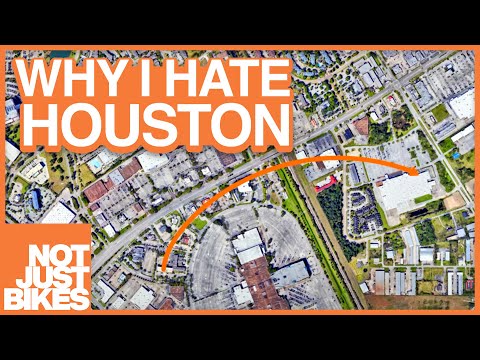
Why This Channel Exists (and why I hate Houston)
About this video
Not Just Bikes explains why the channel exists, through the creator's walk in suburban Houston. It shows how car-dependent design makes cities hostile to pedestrians.
Why it appears in the archive
Strongly recommended as the entry point to a channel on urban planning and car dependency in North America.
AI-generated summary and labels from the source dataset; verify important details against the video. Source & credits.
From the Hacker News discussion
For anyone who has trouble understanding this perspective because they've lived in car-dependent hell their entire lives, I recommend the Not Just Bikes channel. He does extremely detailed comparisons of US cities vs Netherlands and other places. Here is a recent one [1]. For me, I always felt that something was wrong about American cities / suburbs but I couldn't quite put my finger on it. Then, I spent a few months in Tokyo and something "clicked". It's an entirely different paradigm that forced me to reevaluate what I thought was possible. When I returned to the US, on the ride from the airport my first thought was: Everyone in this traffic jam is going the same direction, and would fit in a handful of train cars. Why are we OK with this?? People say trains are expensive, but they don't realize how much money we spend on cars. Americans spent $1.1 TRILLION on personal vehicles in 2017 [2], not including the hundreds of billions spent yearly on road maintenance. Redirecting a fraction of that money would more than pay for high-speed rail. Let's do a crude estimate. Using the chart here [3], we can expect to pay somewhere between $3-163 million USD per mile of high-speed rail. The distance from NY to LA is 2789.9 miles. At $100M/mile, which is excessive, it would still only cost $279 billion. We could build THREE transcontinental high-speed rail lines every year with the money we spend on personal automobiles. If we're as cost-effective as Japan at $2.6 M / mile, we could af
Read original comment ↗It also has a lot with the car-centric nature of urban planning. Can't recommend this guys entire channel of videos enough: [LINK] He delves into a movement known as "Strong Towns" that look to undo a lot of the mistakes city planners have been making for the last half century. Edit: Here's a link to another of his videos where he shows why it is dangerous to walk in many North American cities: [VIDEO]
Read original comment ↗> The reality is the western world is falling behind in essential infrastructure in every capacity. Could you expand on this? What do you mean? > Its hard to build roads, highways, sewers these days without some pushback. We need to start changing our views and start seeing constriction as an essential human need and return to the old view of infrastructure as something we take pride in For me, it's not "construction" by itself, but I suspect it's pushback against urban sprawl and poor urban design. I watched an excellent video about Houston: [VIDEO] It takes awhile to get to the point, so you might want to skip to 3:42.
Read original comment ↗For those interested in urban planning, including contrasts between the US and places that do it well, I highly recommend the Not Just Bikes youtube channel. The intro video details a short walk in Houston, which is pretty alarming: [VIDEO]
Read original comment ↗I'm not going to argue with you about the different definitions of public transportation, but for sure "taxi" isn't what comes to mind when someone mentions public transportation. The point you're making is exactly the problem. The reason bus lines aren't used more is because they suck in a lot of cities. Improving the public transportation infrastucture (and no, not taxis), would solve this problem - as demonstrated in many European cities. Here's a good video that compares the city planning of Houston to other cities, and explains why it sucks. It focuses more on cars vs. bikes, but the same basic point also applies to public transportation: [VIDEO]
Read original comment ↗People in the US have developed an aversion to walking because our built environment makes it terrible. For example, watch this video from about 4:25 on showing a typical urban pedestrian journey the US: [VIDEO] (One thing the narrator mentions is shade: Keep in mind that Houston is a hot city, with temperatures often above 30c during the summer.) But that's not unusual at all. In fact, where I grew up in Pennsylvania many roads had literally no sidewalk. Let's say I want to walk into town where my parents live. I'd be going down this road (you can follow along on street view): [LINK] That's a narrow road, but don't let it fool you. People there drive fast and they're in a hurry. They certainly do not expect to see someone trudging along the berm of the road. Or more likely in a muddy ditch beside the road, because Pennsylvania is wet and that's the safest way to not get hit by a car. If you walk along into North Wales, PA, pay attention to the pedestrian infrastructure. Where are there sidewalks? Are there crossing signals? How would you know when it's safe to cross? Now imagine doing this in the evening (note: there are no streetlights).
Read original comment ↗Oh, the rabbit hole goes much much deeper. American infrastructure is actively hostile to people walking/biking/doing anything else than driving and even then not very safe. I'd recommend the NotJustBikes youtube channel that really drives the point home, e.g. [VIDEO]
Read original comment ↗Watch some videos from this channel and you'll be able to see how the US definitely does not do enough in terms of creating safe road infrastructure for all: [LINK] [VIDEO] [LINK]
Read original comment ↗