 HackerTube.runGood videos, with context.
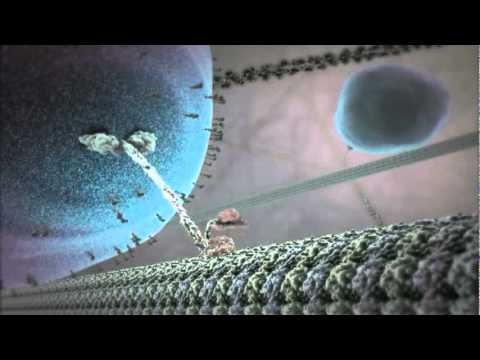
The Inner Life of the Cell Animation
About this video
An award-winning 3D animation by XVIVO for Harvard's BioVisions showing the molecular machinery inside a cell as a white blood cell responds to a stimulus.
Why it appears in the archive
Recommended as a jaw-dropping view of the complexity and machine-like nature of cells.
AI-generated summary and labels from the source dataset; verify important details against the video. Source & credits.
From the Hacker News discussion
* 'Small proteins also promise to revise the current understanding of the genome. Many appear to be encoded in stretches of DNA—and RNA—that were not thought to help build proteins of any sort. Some researchers speculate that the short stretches of DNA could be newborn genes, on their way to evolving into larger genes that make full-size proteins. Thanks in part to small proteins, "We need to rethink what genes are," says microbiologist and molecular biologist Gisela Storz of the National Institute of Child Health and Human Development in Bethesda, Maryland.' Wow. Amazing how incredible biology and proteins are and their still-barely-understood mechanisms. For anyone who hasn't already seen it, I highly recommend The Inner Life of a Cell [0] [0] [VIDEO]
Read original comment ↗This video blew me away: [VIDEO] It's an animation of the bio-chemistry a lymphocyte uses to move between cells (maybe - that's a guess?). It covers what I can only assume is a few milliseconds, it's just a tiny slither of the cells behaviours, yet how much is going on to make that happen is off the charts. I showed in it a club consisting of mostly software engineers, and the universal reaction was "thank god I didn't do bio-chemistry".
Read original comment ↗Motor proteins are so incredibly cool. Like many others I was blown away by the 3D animated Inner Life of the Cell[1] showing these proteins physically walking around in the cell. Previously I had this idea that cells were just blobs of jelly and somehow they interacted with each-other to produce macro phenomena like muscle movement. And then you get into the other protein machines like the ATP synthase in the mitochondria [2] (also linked below) which are actually little motors/pumps. And we all have billions of these inside use spinning away. It's just amazing. 1. [VIDEO] 2. [LINK]
Read original comment ↗Appreciate the share. I've seen a compilation of these clips out of context and loved them. Never figured out where they came from. They really are amazing in striking the balance between organic and mechanistic. The Kinesin in particular are cute. [VIDEO] This video shows it quite well too. EDIT: looks like someone else shared the same.
Read original comment ↗>> I think our brains are machines for predicting what happens next. > Technologist thinks that humans are machines (breaking news) While I also dismiss or at least be careful of the inherent biases of technocratic viewpoints, humans and life in general are very much made of many types of machines. Take a look at these videos: [VIDEO] [LINK] I.e., life is insane and bewildering.
Read original comment ↗Proteins are the machines produced to atomic specification by a genetic blueprint encoded in DNA. The are the tools life uses to accomplish most of its tasks. Proteins are formed like 'beads on a string' - a chemical single-dimensional chain, where twenty different chemical 'amino acids' are mix-and-matched. The amino acids are strung from an 'N' terminus to a 'C' terminus in order to produce nearly every machine all biology uses for every task a cell might need to survive - structural, chemical, metabolic, energetic, sensation, etc. Once produced, the chain of amino acids folds in on itself in 3D, and many 'motifs' or 'domains' have particular functions as sets of tens to hundreds of amino acids. The software, Pinecone, allows you to characterize and then mix-and-match those domains to produce protein machines with novel function. It is essentially a 1D CAD program that outputs 3D atomically defined objects, but compiles down to DNA that nearly any organism can read. It's not all that different from a molecular Kerbal Space Program - a hardware store for protein domains - but one where you can press 'print' and get your DNA delivered. - Protein Domains: [LINK] - How proteins are made: [LINK] - Visualization of protein machines in use: [VIDEO] - Economically, socially & therapeutically valuable Proteins: [LINK] The basic concepts and terminology are a mix of biochemistry and molecular biology and are describing organic machines that are thousands to hundreds of thousands of a
Read original comment ↗Yeah, but if this (below) is happening inside a single cell, doesn't it seem much easier to model a single worm than to model a single cell? Inner life of a cell: [VIDEO]
Read original comment ↗