 HackerTube.runGood videos, with context.
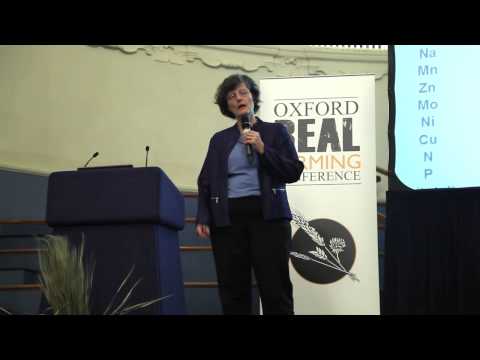
The Roots of Your Profits - Dr Elaine Ingham, Soil Microbiologist, Founder of Soil Foodweb Inc
About this video
Soil microbiologist Elaine Ingham speaks at the Oxford Real Farming Conference on how soil organisms cycle nutrients, unlock minerals from rock and air, and why pesticides and fertilizers harm soil life. Slides are linked in the description.
Why it appears in the archive
HN commenters cite her as the explanation for why soil biology, not added fertilizer, drives plant nutrition and farm results.
AI-generated summary and labels from the source dataset; verify important details against the video. Source & credits.
From the Hacker News discussion
>if neonicotinoids are a net win for agriculture The logic here seems to be that: * Farmers buy neonicotinoids. * Therefore, neonicotinoids have a net positive effect on agriculture. (in other words, like a good libertarian you are assuming that the market has complete/perfect/accurate information) Unfortunately that's just not true. Today's farmers simply don't have the required soil science/botany/ecology/hydrology knowledge. Worst, they are actively misled by biocide and fertilizer salesmen, who have a natural profit motive to convince farmers that their products are essential. Far from being essential, in reality pesticides destroy the nutrient harvesting ability of healthy soil. Soil microbiologist Dr. Elaine Ingham explains: [VIDEO]
Read original comment ↗>Because the alternatives to neonicotinoids are broader-spectrum pesticides Well 'ere's yer problem! ;) You're starting off by assuming that agriculture must use pesticides to grow food. But is that really true? I submit to you that it is not. Furthermore, I submit that a food system that depends on pesticides is doomed to self-destruct (because of inevitable biogeophysical processes). Pesticides destroy the nutrient cycling microorganisms in the soil leading to infertility, erosion, and ultimately desertification. Again, soil microbiologist Elaine Ingham explains the process better than I could: [VIDEO] >I don't know why you insist on being so overtly hostile You're right. My apologies, and edited.
Read original comment ↗> If I eat a banana that has potassium in it, it lends to the fact that it took potassium out of the soil. This is true. However the little-known fact is that healthy soil contains all the "machines" required to break down the abundant insoluble potassium (along with every other necessary element) present in rock particles into plant-soluble fertilizer. This "insoluble pool" contains enough nutrients for literally thousands of years of plant growth, if only the soil life is present to unlock it. The problem is that tillage kills this soil life, and that dead land now requires the constant import of external fertilizer to grow food. Pesticide and fertilizer application also kills these organisms, which out-compete pest species (as mentioned here: [LINK] ). Spraying becomes a vicious cycle for the farmer, and a lucrative cycle for their chemical supplier. In other words, functional soil isn't just an inert "tank" for holding nutrients. It's a two-dimensional factory for converting in-situ rock and air and rain into biomass. This is all explained much better by soil microbiologist Elaine Ingham. [VIDEO] > luckily engineers and farmers are looking at these things more closely now. I would add biologists (including soil scientists, botanists, mycologists, entomologists, ecologists, etc) and indigenous experts to that list.
Read original comment ↗Also see, very significantly, Elaine Ingham, soil (biology) scientist, Ph.D., also founder of startup soilfoodweb.com (to consult and get her research applied widely). Almost all the farmers I mentioned above, quote her work with respect and apply it in their operations, and consider it key to their results. She (along with many other researchers, over years, not a sudden thing) has come out with some rather startling results that, as I said, are being applied by these guys and many others. A key result is that it is the quantity and diversity of the life in the soil that is as (or more) important to soil health and hence farm results (now and long term) as the actual levels of plant nutrients in the soil. And this is because it is the soil life (they use the term "biology" for it, but okay, go with the prevailing term the experts use) that makes the chemical nutrients available in forms that plants can actually use, via a deep symbiosis and mutual helping that happens between plants and the soil biology, which includes bacteria, fungi, archaea, nematodes, arthropods and small animals. Another quite surprising / non-intuitive result is her saying that most or all soils on earth, already have many times more the amounts of nutrients than plants need, like 1000x more, including macro (e.g. N, P, K) and micro ones (like trace elements), so the limiting factor is really the soil biology, which depends a lot on soil organic matter content (all those critters need to eat), humidity
Read original comment ↗For a practical discussion of how this biotic cycling connects to agriculture, Dr Elaine Ingham delivers a salient presentation.[0] [0] [VIDEO]
Read original comment ↗Yes. I keep sharing Gabe Brown's three-part video series titled Treating the Farm as an Ecosystem, now and then, here on HN, whenever such threads come up. Some really solid practical and pragmatic stuff there, on regenerative agriculture, which, as I understand it [1], goes beyond organic farming, and is related to many of the issues talked about in this thread. [1] I had done organic gardening successfully, for a few years, some time earlier, so I have at least some practice and experience (and also a lot of reading and thinking about what I read) as the basis for my opinions of his work and those of others I mention, such as Elaine Ingham (a video by her is below too). One of her most astonishing finds / claims is that (IIRC, I saw the video a few years ago), almost all soils anywhere on earth have more than enough nutrients for plants for many many years. She said the real issue and limitation is the lack of soil organic content and soil structure and mycorrhiza ( [LINK] ), without which even applying tons of nutrients is useless. And, Gabe has a big farm, a few thousand acres (so not small scale) in North Dakota, USA, with field crops, green manure, livestock on pasture / prairie, etc. And is making profits from his farming operations, sustainably, even regeneratively, without government subsidies, and more than his conventionally-farming neighbors, some of whose soils are getting worse, while his get better over time, by objective measures (checked by external govt. age
Read original comment ↗> Living soil consumes rock minerals making them available to plants. Thank you. This is one of those super-underappreciated biological facts. Industrial ag treats soil like it's a tank of fertility, and guess who sells the refills? Biologists know that healthy soil is a factory , making new fertility out of rock/air/rain/sun. Direct from soil microbiologist Dr Elaine Ingham: [VIDEO]
Read original comment ↗Synthetic materials don't come from nothing. Following the supply chain backwards they're all[1] mined from somewhere, either as fossil fuels or minerals like potash and limestone. All the NPK fertilizers (which this system uses) come from mined materials. Far from "not harming plants or animals," this material extraction comes with huge (but externalized) ecological, social justice, and wealth concentration problems. And of course it's completely unsustainable. Now compare that to how healthy soil functions: microorganisms leach minerals directly from grains of sand/loam/clay, essentially manufacturing in-situ minerals into bioavailable form right at the root zone. Nitrogen fixation is similar, performed by leguminous plants using otherwise wasted sunlight and ISRU. [VIDEO] [1] Since I know someone will bring it up, some do come from plants like soybeans. But mechanized soybean production is primarily either soil mining or (in areas with badly degraded soil) entirely supported by fossil fertilizers.
Read original comment ↗