 HackerTube.runGood videos, with context.
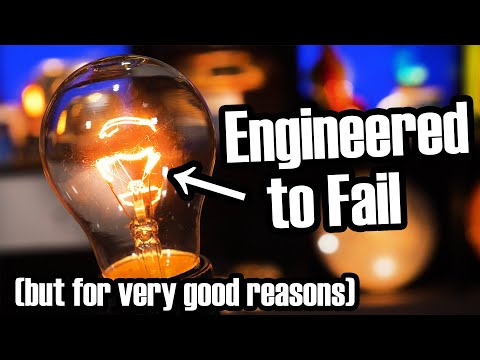
Longer-lasting light bulbs: it was complicated
About this video
Technology Connections examines why light bulbs have the lifespans they do, including the real history of the Phoebus cartel. He shows that bulb life trades off against brightness and efficiency rather than being simple planned obsolescence.
Why it appears in the archive
HN's go-to link for correcting the lightbulb conspiracy myth, giving an engineer's view of the lifespan versus efficiency tradeoff.
AI-generated summary and labels from the source dataset; verify important details against the video. Source & credits.
From the Hacker News discussion
There is an excellent video about Lightbulb Cartel by Technology Connections, highly recommended if you want an engineers perspective, with no 'great conspiracy' hype. [VIDEO]
Read original comment ↗Technology Connections talked a lot about this and the supposed planned obsolescence of light bulbs [VIDEO] TL;DW: (if I rember correctly) Bulbs with shorter lifespans are generally more energy efficient. There was good reasons to not making bulb that last forever.
Read original comment ↗Honestly that story is really not as simple as people suggest it is. There is a tradeoff between bulb life and brightness and standardization may have been good for the industry. Technology Connections does a thoughtful deep dive in to this story in this recent video: [VIDEO]
Read original comment ↗Its a bit of a myth for ever lasting bulbs, its more complicated than that. The life time was a trade off of colour and brightness. If you made them very red shifted and quite dim then there are bulbs that are very old still around, but they don't produce much light and never did. The harder you drive the filament the better the light properties but the quicker it died. The industry choose a point for trade offs as a standard. You can watch about the history of it on Technology connections. [VIDEO] Saying that the Dubai Philips LED bulbs really do last a lot longer since they have twice the filaments and run the filaments a lot less hard as a result (as well as being more efficient). It is possible nowadays to make an LED that wont fail anytime soon although LEDs are already much better than incandescents in that regard but there are ones that will likely survive your lifetime available at a higher price but only in Dubai. Most LED bulbs are designed to fail sooner, but they are also cheaper. Those 10k recharge batteries are absolutely coming and we will have them in a few years time, li-ion as it stands today will simply be obsolete.
Read original comment ↗Nice video from the well known channel Technology Connections: [VIDEO] => It's complicated. Yes, there was a cartel, but it was not all bad. There were legitimate reasons to go for 1000h light bulbs.
Read original comment ↗It wasn't as simple as them wanting to make more money: [VIDEO] Key points from an AI summary: - Incandescent bulbs had to balance factors like light output, efficiency, and lifespan - hotter filaments produced brighter, whiter light but reduced bulb lifespan. - Longer-lasting bulbs were less efficient and produced dimmer, yellower light, so they were not simply "better" products being suppressed. - The 1,000 hour target was a reasonable compromise that balanced these competing priorities, not necessarily a sinister plot. - Even after the Phoebus cartel dissolved, the 1,000 hour lifespan remained the industry standard for general-purpose incandescent bulbs.
Read original comment ↗Actually Technology Connections made a great youtube video on this: [VIDEO] The gist is that by running bulbs at a lower power, you can greatly prolong its life, but the downside is that it doesn't heat up as much, and since emissions spectrum correllates with temperature, ends up being much worse at converting electricity to light, which ends up being not worth it.
Read original comment ↗It's true that the Phoebus cartel arranged to have light bulbs die after a certain number of hours, but bulb lifetime is a trade off between lumens, filament life, and energy consumption. The cartel-defined lifetime limit sits very close to the sweet spot for all of those metrics for incandescent bulbs. Technology Connections explained this well in a video about a year ago: [VIDEO]
Read original comment ↗