 HackerTube.runGood videos, with context.
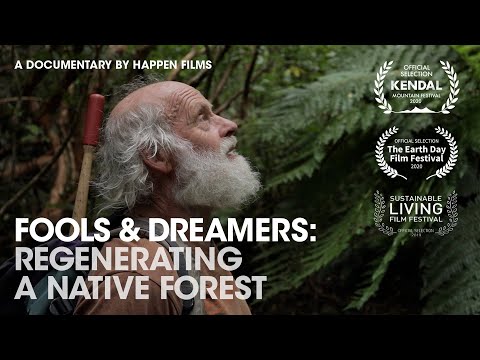
Man Spends 30 Years Turning Degraded Land into Massive Forest – Fools & Dreamers (Full Documentary)
About this video
Fools & Dreamers is a 30-minute documentary about Hinewai Nature Reserve in New Zealand, where botanist Hugh Wilson let gorse grow as a nurse canopy to regenerate native forest. It shows the results after 30 years and the local skepticism he faced.
Why it appears in the archive
Shared in climate and land-use threads as a vivid example of how letting land regrow can restore forest.
AI-generated summary and labels from the source dataset; verify important details against the video. Source & credits.
From the Hacker News discussion
Here’s an encouraging story for New Zealand: [VIDEO] “Fools & Dreamers: Regenerating a Native Forest is a 30-minute documentary about Hinewai Nature Reserve, on New Zealand’s Banks Peninsula, and its kaitiaki/manager of 30 years, botanist Hugh Wilson. When, in 1987, Hugh let the local community know of his plans to allow the introduced ‘weed’ gorse to grow as a nurse canopy to regenerate farmland into native forest, people were not only skeptical but outright angry – the plan was the sort to be expected only of “fools and dreamers”. Now considered a hero locally and across the country, Hugh oversees 1500 hectares resplendent in native forest, where birds and other wildlife are abundant and 47 known waterfalls are in permanent flow. He has proven without doubt that nature knows best – and that he is no fool.”
Read original comment ↗I enjoy sharing the short film in this vein, "Fools and Dreamers", that follows a group that bought some land in New Zealand and let it return to forest over 30 years. [VIDEO]
Read original comment ↗This is a great short film that goes into detail about the project and the challenges faced in getting it off the ground: [VIDEO]
Read original comment ↗Frankly, yes, they do fix themselves. You'd be utterly shocked at what landscapes look like if we leave them. Having been part of forest regeneration efforts across the UK for the past 8 years - from southern heathlands to rocky Welsh and Scottish outcrops, good for "nothing but sheep" - I can say with all certainty that every part of the country except the most extreme alpine regions is suitable for reforestation or some form of plantation dense rewilding, mooring, wild flower meadow, etcetera. The same can be said of much of Canada and America, with my peers over there having the same results when grazing stops. Hell, the Mongolian steppes are turning to results of goat herding, and the Gobi desert is though to have been cause by the same. In the UK for example, people are completely ignorant to how the place looked before we levelled it for grazing, viewing the 70% ecologically barren agricultural land (of which 80% of that is used for grazing or agriculture to feed cattle) as the norm and the 2.5% old growth forest as a more novelty, and something strangely "unique to that area". The country was 60-80% temperate rainforest before human habitation, depending on what research you go by. This video is especially poignant, and really shows the dramatic impact simply doing nothing has: [VIDEO]
Read original comment ↗There's a guy in New Zealand I met who spent the last 30 years rewilding what was previously agriculture herding land. He said his biggest frustration with land owners wasn't the push back on what he was doing, but the ignorance as to what could be achieved. Every single person he spoke to told him explicitely if the land was left to go to nature, it would be nothing but gorse and it was a waste of good grazing land. The actual result was a return of native rain forest with levels of species diversity that were almost 60% of untouched rainforest, which is pretty incredibly in such a short amount of time. This is the guy for context - it's a very interesting video that really highlights the impact that over-grazing has: [VIDEO]
Read original comment ↗Yup that's the other approach;) Can achieve impact in another way too (e.g. Hugh Wilson [VIDEO] ) But then it gets harder/costlier to access opporunities, facilities (eg health care) and infrastructures, as well as social and monetray capitals and (economical and politcal) power.
Read original comment ↗Same in the UK (barring the mammals point). The country was 60-80% temperate rainforest before human habitation, depending on what research you go by. I grew up in the countryside. I cannot tell you how impossible it is to convince someone, who is dead set on consuming animal products, that we could regenerate that land if only we got rid of the cattle/fodder though. It's always "that land can't be used for anything else" or "having animals grazing there is good for the land", and that is just demonstrably false in every way. It's baffling that there can literally be old growth forest just on the other side of the hill, and the farmers will be adamant that the land they're on would be useless and barren if it weren't for them - as they continue to staunchly cut back the hedgerows and mow their fields every few months. Having been part of forest regeneration efforts across the UK - from southern heathlands to rocky Welsh and Scottish outcrops, good for "nothing but sheep" - I can say with all certainty that every part of the country except the most extreme alpine regions is suitable for reforestation or some form of plantation dense rewilding. People are completely ignorant to how the country looked before we levelled it for grazing, viewing the 70% ecologically barren agricultural land (of which 80% of that is used for grazing or feeding cattle) as the norm and the 2.5% old growth forest as a more novelty, and something strangely "unique to that area". If you're from New Zeal
Read original comment ↗> My argument was simply that it's not enough on its own There is not a magic bullet at this point ... we have to do many things to correct the overshoot. > reforestation can help, but that's not synonymous with stopping animal ag, although of course there is overlap Animal agriculture occupies as much space as all our forests do. The overlap and deforestation that have occurred over millennia are highly significant. [LINK] > doing so at the necessary scales would be incredibly disruptive to world cultures and economies There are many reasons why we need that. Without abundant biodiversity we might see collapse of animal populations, and we might lose remaining pollinators, for example. We won't have any economy without those services we take for granted from the nature. [LINK] If you're ethical vegan, you'll know that culture is just stories we tell ourselves, and those stories are/were very often wrong (like slavery, for example). I don't have to tell you that with animal ag. we're taking something from those animals that isn't ours to take. I'll suppose from now on that you're a vegan and I don't have to explain this to you anymore. [LINK] > is not going to go vegan or vegetarian It's something we have to do, no matter what anyone thinks. We don't have enough space to feed everyone a meat and dairy diet in the quantities that Westerners consume. We could attempt to do so, but that would result in the total collapse of ecosystems and our own demise. [LINK] One study estimat
Read original comment ↗