 HackerTube.runGood videos, with context.
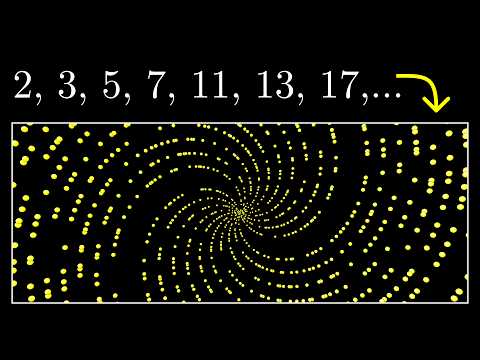
Why do prime numbers make these spirals? | Dirichlet’s theorem and pi approximations
About this video
3Blue1Brown explains why plotting primes in polar coordinates produces spiral patterns, using modular arithmetic, Dirichlet's theorem and rational approximations of pi.
Why it appears in the archive
Frequently recommended as the clearest explanation of prime spirals and the Ulam spiral.
AI-generated summary and labels from the source dataset; verify important details against the video. Source & credits.
From the Hacker News discussion
Here is one of the most enlightening explanations for these kinds of spirals I have seen by 3blue1brown: [VIDEO] Note that the setup is slightly different,since in that video they plot numbers along their polar coordinates. The results are very similar, since both create spirals with predictable angular offsets.
Read original comment ↗The first time I saw these, I thought it hinted at some deep insight into the nature of primes. However, after watching the following video, I think it just says something about modular arithmetic and rational approximations of 2 Pi. [VIDEO] The video is only about Archimedian spirals, but I suspect a similar analysis would apply to Ulam spirals too. We really like to find patterns.
Read original comment ↗In this vein, I really enjoyed 1brown3blue breaking down why prime numbers form patterns when graphed in polar coordinates. [VIDEO]
Read original comment ↗3B1B has a semi related video on how working with prime numbers can help you see properties that are also found in composite numbers, since the sequence of primes overlaps with many other sequences. [VIDEO]
Read original comment ↗For IMO a more meaningful phenomenon, this video by 3Blue1Brown explains why primes plotted as (p, p) in polar coordinates produce interesting patterns. [VIDEO]
Read original comment ↗Numberphile[1] and 3b1b[2] (with a particularly good explanation of why it happens) have done good videos on the prime spiral. [1] [LINK] [2] [VIDEO]
Read original comment ↗> But after a fairly small size, there's almost no utility in visualizing graphs. I want to stress this point and go a bit further. It can be worse as people have pareidolia[0], a tendency to see order in disorder. Like how you see familiar shapes in the clouds. There is a danger in that with large visualizations such as these that instead of conveying useful information, you counterproductively convince someone that something that isn't true is! Here's a relevant 3B1B video where this is kinda discussed. There is real meaning but the point is that it is also easy to be convinced of things that aren't true[1]. In fact, Grant's teaching style is so good you might even convince yourself of the thing he is disproving as he is revealing how we are tricked by the visualization. Remember what the original SO person latched onto. I think it's important to recognize that visualization is a nontrivial exercise. Grant makes an important point at the end, restating how the visualization was an artifact and how if you dig deep enough into an arbitrary question, you _can_ find value. Because at the end of the day, there are rules to these things. The same is true about graphs. There will always be value in the graph, but the point of graphing is to highlight the concepts that we want to convey. In a way, many people interpret what graphs are doing and why we use them backwards. You don't create visualizations to then draw value from them, but rather your plots are a mathematical analysis
Read original comment ↗I've got Pi memorised more precisely than 355/113 as well for no good reason, and for engineering applications it doesn't serve any purpose. But the fraction is weirdly close and that's interesting for other (more academic) reasons, such as explaining why plotting primes in polar coordinates looks like a pattern: [VIDEO]
Read original comment ↗