 HackerTube.runGood videos, with context.
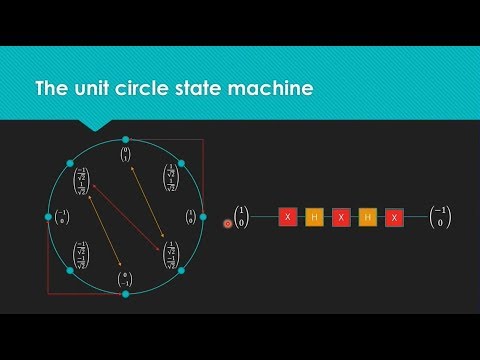
Quantum Computing for Computer Scientists
About this video
An 88-minute Microsoft Research talk that explains how quantum computers beat classical ones using basic linear algebra, qubits, superposition and gates. It works through the Deutsch oracle problem and ends with entanglement, teleportation and a live demo.
Why it appears in the archive
It is HN's most frequently recommended starting point for quantum computing because it avoids pop-science hand-waving and needs only basic linear algebra.
AI-generated summary and labels from the source dataset; verify important details against the video. Source & credits.
From the Hacker News discussion
The Quantum Computing for Computer Scientists video by Microsoft Research ( [VIDEO] ) really hammered it home for me. It goes slowly and the presenter, in his own words "shuts up and does the math".
Read original comment ↗[VIDEO] This video is the simplest explanation that I have found for Quantum Computing which doesn't do the whole pop-sciency "is both zero and one at the same time" nonsense.
Read original comment ↗Here is a video of a researcher at Microsoft Quantum lecturing on this: [VIDEO] "Quantum Computing for Computer Scientists.". However, even with understanding how a Quantum Computer works at its most basic level I still have difficulty understanding the more useful Quantum Algorithms: [LINK] [LINK]
Read original comment ↗I’ve begun to put together useful resources for learning more here: [LINK] I’d like to really flesh out that page; I’ve now come across so many folks that are amazing at explaining this stuff... It’s just a time crunch to juggle all this as you might imagine ;) These two videos in particular helped me get started: 1. What is a physical quantum computer? [LINK] 2. How might one compute using it? [VIDEO]
Read original comment ↗Learning Quantum Computing based on skill level (math is the biggest friction point, suggested pdf should save you lots of time) (Recc is personal recommendations, Hi-Recc is look at ASAP) # QC Main Ideas - Rotate, Compute, Rotate - Think in Amplitude Interference # Beginner: -(Hi-Recc) Quantum Computing Primer (1.5hr) : [VIDEO] -(Hi-Recc) Math Primer for Quantum Computing (easiest intro/primer I found on the topic; Highly Recommend ) : [LINK] -- understand Bra Ket notation [<Bra|Ket>] (Ket as Column vector, Bra (Row vector) as Complex Conjugate of Ket (denoted as dagger) ) -- understand Kronecker product ( for multi-qubit systems) - Quantum Computing for Computer Scientists book - [LINK] - Quantum Math Primer (Faculty of Khan) (found a bit hard the first time around, pretty dense) : [LINK] # Intermediate -(Recc) Ryan O'Donnell CMU course [is the best if you want to really understand the capabilities of quantum computing, get practice with math, intuition] (algos connection to Fourier, Quantum Complexity Theory, Math best practices, learning multi-quibit systems) -- Quantum Computation and Information at CMU : [LINK] -- Lecture Notes (use as reference in case video is not clear, or camera shot lags/changes) [LINK] - Mermin's Textbook [LINK] - Nielsen & Chuang's Textbook [LINK] -- Nielsen's Lectures [LINK] # Advanced -(Recc) Scott Aaronson Graduate Course [LINK] -(Recc) Scott Aaronson Papers (really interesting) [LINK] - Complexity Zoo - List of Algorithms [LINK] -(Recc) Machi
Read original comment ↗If anyone is interested I've also created a short 1.5 hour lecture on quantum computing aimed specifically at software engineers & computer scientists, which has proven popular: [VIDEO] I'd love to answer any questions people have. In quantum computation, state behaves like a vector and logic gates behave like matrices that multiply the vector to get a new state value. It doesn't get too much more complicated than that.
Read original comment ↗Here is a long-ish video that explains quantum computers without using pop-science hand-wavy terminology [VIDEO]
Read original comment ↗There is absolutely no way to understand quantum mechanics without learning the math. All metaphors are faulty and will lead you to incorrect conclusions. Fortunately the advent of quantum computing has made the math quite easy - it's just linear algebra of the type one would pick up within the first week of an undergraduate course. I made a video aimed at computer scientists which you might find useful: [VIDEO]
Read original comment ↗