 HackerTube.runGood videos, with context.
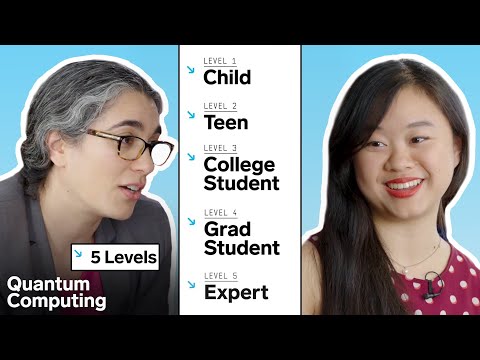
Quantum Computing Expert Explains One Concept in 5 Levels of Difficulty | WIRED
About this video
IBM's Dr. Talia Gershon explains quantum computing to five people of increasing expertise: a child, teen, college student, grad student and professional. The WIRED series format moves from simple analogies to technical detail.
Why it appears in the archive
HN points to it both as an approachable quantum computing intro and as an example of explaining one concept at multiple levels.
AI-generated summary and labels from the source dataset; verify important details against the video. Source & credits.
From the Hacker News discussion
Try this video - [VIDEO] I found it easy to comprehend. It starts explaining to a child & works its way up to a doctorate level.
Read original comment ↗I’ve begun to put together useful resources for learning more here: [LINK] I’d like to really flesh out that page; I’ve now come across so many folks that are amazing at explaining this stuff... It’s just a time crunch to juggle all this as you might imagine ;) These two videos in particular helped me get started: 1. What is a physical quantum computer? [VIDEO] 2. How might one compute using it? [LINK]
Read original comment ↗What constitutes reasonable? Here's an example of someone explaining something to five different levels of audiences. [VIDEO] None of these approaches are prima facie "unreasonable." But if you get the wrong level it won't feel useful. I don't think it's crazy to have open teaching discussions on HN, I think you lay out a fair hope that someone can break something down here. But I'm just not sure which level you're looking for. Precision and simplicity are often competing constraints.
Read original comment ↗"sparsity is a useful measure of interpretability, since humans can handle at most 7±2 cognitive entities at once " If you are going to limit models to 9 features, or 9 combinations of features, or 9 rules, models are not going to work as well. This just seems like a very weak argument to introduce. "A black box model is either a function that is too complicated for any human to comprehend, or a function that is proprietary" These seem like two very different things. A false equivalence is then made with many arguments against proprietary models being made as if they apply to complex models. "It is a myth that there is necessarily a trade-off between accuracy and interpretability....However, this is often not true" It's a bit of a straw man to suggest that there is "necessarily" a trade-off, as there are surely cases where there is not. One could say that there is "often" a trade-off between accuracy and interpretability. I don't think there are many people out there with the naive view that one should never do feature engineering. "If the explanation was completely faithful to what the original model computes, the explanation would equal the original model" This is just nonsensical to me. The idea is not to be completely faithful, but to raise things up to another level of abstraction. The series of videos from Wired comes to mind where a concept is explained at multiple levels. [VIDEO] "Black box models are often not compatible in situations where information outside the da
Read original comment ↗Here are few thoughts on Aaranson's comments: 1) I have absolutely zero understanding of quantum computers (even after watching this video: [VIDEO] ), though I like to read up on quantum physics. However, it seems to me that I've lived through many "breakthroughs" in this technology. For example, here's an excerpt from a NYT article from 4/28/1998: [LINK] : The discovery has touched off a wave of excitement among physicists and computer scientists and is leading dozens of research centers worldwide to embark on similar experiments heralding the advent of an era of so-called quantum computers, specialized machines that may one day prove thousands or even millions of times faster than today's most powerful supercomputers. It seems quantum computers that can kick ass is always 10-15 years away. 2) Here's a writeup from Pano Kanelos, President of the University of Austin of University of Austin, where he explains the motivation: [LINK] . Others can debate the anti-wokeness, but this part is pretty much fact: Over the last three decades, the cost of a degree from a four-year private college has nearly doubled; the cost of a degree from a public university has nearly tripled. Colleges in the US are insanely expensive! If the new UoA starts fixing that I'm all of it, but I'll believe it when I see their tuition rates and first batch of graduates. This is the first question listed here (along with the high cost of healthcare in the US): [LINK] 3) The blog post he mentions is interest
Read original comment ↗One of the IBM scientists seems to have an old quantum computer as a piece of office decoration, so I guess there's some hope to preserve them: [VIDEO]
Read original comment ↗