 HackerTube.runGood videos, with context.
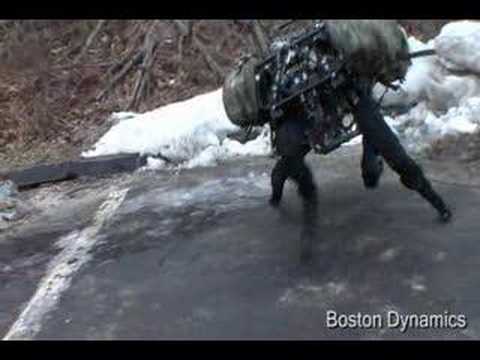
Boston Dynamics Big Dog (new video March 2008)
About this video
Boston Dynamics' March 2008 video of BigDog, a four-legged robot, walking on ice and snow, climbing rubble and recovering from slips and kicks.
Why it appears in the archive
HN returns to it as the classic jaw-dropping demo of legged robots handling rough terrain, and as a historical marker for how long such robots have existed.
AI-generated summary and labels from the source dataset; verify important details against the video. Source & credits.
From the Hacker News discussion
I thought Toyota was pretty good until I followed the link in the article to Big Dog. [VIDEO] Big Dog is truly awesome. It runs, jumps, recovers from slips, climbs over rubble, ...
Read original comment ↗Here's some specific suggestions. I was most recently fascinated by this video on head tracking "virtual reality". [LINK] Another cool thing if you're into DIY robots (not really educational, but I found it inspiring) is the Yellow Drum Machine. [LINK] Not sure why I got on the robot tangent but here's another good one, a 4-legged robot that's pretty good at navigating hills and obstacles. Especially the recovery from a fall sequence around 1:25. [VIDEO] And here is hacking the Wii Fit controller and a Roomba to do a sort of vacuum-by-surfing... thing? [LINK]
Read original comment ↗I find amazing how difficult it is to successfully perform apparently trivial tasks such as walking. There's more information about the 'LittleDog' on the Boston Dynamics website: [LINK] I was really impressed 2 years ago by their video of the 'BigDog': [VIDEO] (check out t=40s)
Read original comment ↗On a more flippant level, isn't it pretty obvious that robot ponies are going to be a thing that is possible to have some time in the next century or two? We've already got something that's kind of moving in that direction, and this was a few years ago: [VIDEO]
Read original comment ↗[LINK] Insight, creativity, and general intelligence are all different and active areas of research. There is quite a lot of progress in creativity. Google for 'creative software'. Insight can mean many things, but Watson can now provide insights into cancer diagnosis. Consciousness is actually fairly well understood in terms of attention, focus, and other aspects. Artificial general intelligence is a very active field seeing quite a bit of progress. Here is a bird that flies with flapping wings: [LINK] (By the way, that is completely unrelated to AI). Walking over uneven terrain, (also completely unrelated to artificial general intelligence): [LINK] [VIDEO] Deep learning is beyond statistical pattern matching. It does involve both supervised and unsupervised learning. Deep learning is currently the most successful technique, but not the most ambitious approach in AGI. Google for 'AGI', 'deep learning', 'sparse autoencoder', 'hierarchical hidden Markov model', 'OpenCog', 'spiking neural network', 'Hierarchical Temporal Memory'
Read original comment ↗Just because he ruled it out doesn't mean that it's not a factor. People become attached to lots of inanimate items, and can feel emphathy for robots [1] [2], though perhaps not as strongly as with living creatures. US Military soldiers can develop an emotional connection with bomb disposal robots. [3] I definitely sympathize with this dog-like robot slipping on ice: [VIDEO] Even though it's clearly a robot with no attempt to make it look or act like a dog. I can definitely believe that people can become attached, even fall in love with, their robot dogs. [1] [LINK] [2] [LINK] [3] [LINK]
Read original comment ↗> > Meanwhile, many of the tasks that seem most basic to us humans—like running over rough terrain or interpreting body language—are all but impossible for the machines of today and the foreseeable future. > Wow no. ...wow indeed. No research at all. Often I just read the comments here and skip the article, but that made me go and look to be sure. For anyone somehow still unaware (BigDog creepiness factor was nearly viral back when I was in college around 2008), BigDog has been handling rough terrain for over a decade: [VIDEO] Here's BigDog getting abused to see what it can recover from (including being kicked in the side): [LINK] Here's a running cheetah robot jumping over unexpected obstacles (2015): [LINK] And here's a two-legged robot walking around outside (2017): [LINK]
Read original comment ↗Progress takes time, and ambulatory motion is a finicky, delicate nightmare that only seems simple in humans and animals thanks to millions of years of evolution. CAM was created in the 1960s[0], but BigDog[1] and other recent Boston Dynamics quadrupeds that aren't designed for human passengers are much faster[2], but still awkward. Also remember these are expensive prototypes designed to test things other than speed. Making them faster only guarantees that they break themselves harder when they run into a wall or trip over a cliff or something. [0] [LINK] [1] [VIDEO] [2] [LINK] >I think Neal Stephenson described a skateboard with hundreds of tiny feet, moving faster than wheels on any surface. I want to see that. I am neither Neal Stephenson nor a physicist but I'm pretty sure the friction caused by the increased surface contact of "hundreds of tiny feet" versus wheels would still make the wheels faster and more efficient. Geckos and things can stick to vertical surfaces and move quickly because they're lightweight. Anything capable of sticking to an arbitrary surface and supporting human weight is going to be slow. And if moving downhill, wheels don't really need to do work - gravity does the work. Something with "hundreds of tiny feet" either has to slide or "walk."
Read original comment ↗