 HackerTube.runGood videos, with context.
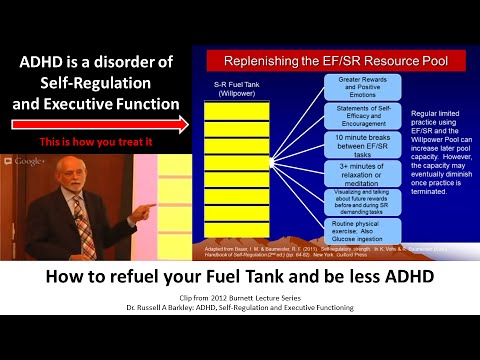
This is how you treat ADHD based off science, Dr Russell Barkley part of 2012 Burnett Lecture
About this video
A short excerpt from Dr Russell Barkley's 2012 Burnett Lecture on ADHD, focused on treatment. He argues ADHD is a disorder of executive function and self-regulation, and that environments should be designed to compensate.
Why it appears in the archive
HN people with ADHD or ADHD-affected relatives share it as an authoritative, practical talk that helped some seek diagnosis.
AI-generated summary and labels from the source dataset; verify important details against the video. Source & credits.
From the Hacker News discussion
Lists, logs, writing, post-its, Todo lists etcetcetc. I tend to forget stuff even while I'm doing it, so it helps a million if what I'm doing is written on a Post-It right in front of me. Also, to keep track of tasks, problems, todos etc, I have a huge text file that is bound to the ctrl-` keybinding (autohotkey script opens a file in sublime text). I think the most important thing is to externalize your mind into your environment, you might forget, but your table or text files won't. Also, make sure to watch Russel Barkley. This man is literally ADHD Jesus. [VIDEO]
Read original comment ↗As a 33 year old who was just diagnosed with ADHD, a few minutes into reading this I knew exactly where it was going. For me, it was when I watched Dr. Russell Barkley's talk[1] and halfway through, it brought me to tears. No one before then had described exactly the way I felt on a daily basis. Since going through a full day of neuropsychological testing and being diagnosed with ADHD-I and starting medication, I feel like the me I think I am, naturally curious, optimistic, and actually following through with the things that interest me. Planning and grad school assignments just click so effortlessly now, and my stress is way down, as I am completing things in a timely manner and not fighting myself at every step of the way. If any of this resonates with you, please talk with a psychiatrist to see if this is something you're unknowingly (and unnecessarily) struggling with. Also,if you're like me and like listening to audio books at 2 or 3x speed, check out Speechify, it allows you to listen to any kind of text including rough scans of books/PDFs. It's been incredibly helpful for required readings in classes. edit: wrong video url [1] [VIDEO]
Read original comment ↗This 13 min video [1] also by Dr Russell Barkley is something of a summery, but the longer one is absolutely worth watching. 1: [VIDEO]
Read original comment ↗Praise? :/ Just diagnosed as an adult partially due to parents not "believing in it," refused testing then and I was blind to it until now. Currently friendless, jobless, broke, homeless and a bazillion unfinished projects not exactly the picture of praiseworthy. ADHD is a misnomer, it's an executive function disorder, but the name will never change because it's embedded in disability laws. Medicating for emotional regulation, continuity of thought, completing tasks and not coming-off as weird are lifesaving... don't avoid medication out of some antivaxx nonsense. Worth watching: - ADHD Child vs. Non-ADHD Child Interview [LINK] - How To Know If You Have ADHD [LINK] - This is how you treat ADHD based off science, Dr Russell Barkley part of 2012 Burnett Lecture [VIDEO] - Dr Russell Barkley on ADHD Meds and how they all work differently from each other [LINK] - The Neuroanatomy of ADHD and thus how to treat ADHD - CADDAC - Dr Russel Barkley part 1c [LINK]
Read original comment ↗According to Russel Barkley (well known and central figure in the ADHD scientific community), you should definitely take short breaks every so many minutes. He recommends 3 mins for every 10 minutes of work, but that's for children. I think you'd want be interested in watching this video [VIDEO] Definitely check out his other work as well, listening to his talks is like reading my own diary... except translated to scientific language
Read original comment ↗> Some people argue that what we're today are calling ADHD should be referred to as emotional impulsiveness. The argument is that lack of emotional control causes all kinds of symptoms ... While that's certainly a major component, I believe sensory stimulation also plays a role. Certain video games for example tend to yield considerably higher dopamine rewards in part due to their elevated degree of stimuli relative to other, less stimulating activities. It's why I can play certain games to a world-class level, and then by the same token attempt to read technical literature but find myself re-reading the same sentence a dozen times over. On that front, I've found that if I really attempt to immerse myself in a topic in every way I can, while simultaneously convincing myself on the emotional front that learning whatever I'm attempting to learn will be fantastic-it tends to result in better attention. It's as if my mind has a minimum RPM requirement to operate, and the primary challenge is just achieving a minimum speed that gets the blades moving. > I highly recommend looking it up, you should be able to find some of his talks on YouTube. Just watched a (partial?) talk of his, thank you. It was quite informative.[0] He mentioned a steady stream of fast-metabolized glucose [to the frontal lobe] helping tremendously. That's in weird contrast to my experience, as I tend to avoid virtually all refined sugars. In fact, I also fast for 16 hours every day, finding that my mental clar
Read original comment ↗I thought you might appreciate this clip from a lecture by Dr. Russell Barkley which explains how to use the environment to compensate for ADHD (externalize everything - time, to-do's, motivation, rewards, feedback) and how to keep your willpower reserves high (frequent breaks, positive self-talk and positive mental pictures, meditation and exercise). [VIDEO]
Read original comment ↗I have ADHD-I and I'm feeling almost exactly the same way, right up to a falling out with a company I had significant ownership in/was part of the founding team. How are your daily routines? Are you taking breaks and pursuing the things you actually enjoy doing? Have you thought much about the kind of experiences that have brought you the most joy/satisfaction in life (both at work and outside of work)? Maybe watch this video and see if it resonates with you. It's a talk by Dr. Russell Barkley on ADHD and it's what made me finally schedule a full analysis (after literally decades of putting it off). [VIDEO] If you'd like to talk I'm here to listen.
Read original comment ↗