 HackerTube.runGood videos, with context.
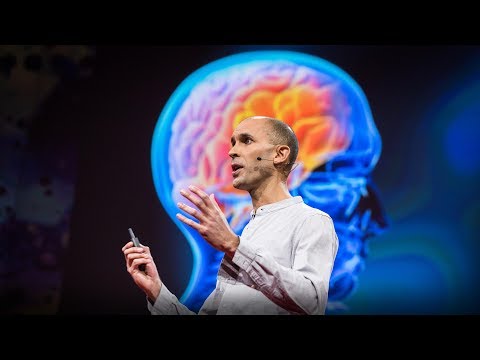
Your Brain Hallucinates Your Conscious Reality | Anil Seth | TED
About this video
Neuroscientist Anil Seth argues in this TED talk that perception is a controlled hallucination: the brain constantly predicts the world and our shared agreement is what we call reality. He also touches on the construction of the self.
Why it appears in the archive
HN cites it whenever threads touch consciousness, perception or predictive-processing, especially for its examples of expectation changing what you perceive.
AI-generated summary and labels from the source dataset; verify important details against the video. Source & credits.
From the Hacker News discussion
I've recently watched this talk titled "Your brain hallucinates your conscious reality" [1] by Anil Seth, seems relevant to the topic. If you are intrigued by the question of the original article you might like the TED talk. [1] [VIDEO]
Read original comment ↗This TED talk has a great example where the same sound sounds different to you based on what you expect to hear, if you need to prove this to yourself [1]. His thesis is also that the brain is a prediction machine. 1. [VIDEO]
Read original comment ↗Reminds me of this: > According to neuroscientist Anil Seth, we're all hallucinating all the time; when we agree about our hallucinations, we call it "reality." [(8) Your brain hallucinates your conscious reality | Anil Seth - YouTube]( [VIDEO] )
Read original comment ↗Somewhat interesting: Bananas contain the ingredients necessary to produce dopamine. I can see how this all plays out as a way for some apes to get some bananas. Even social structures, fairness and other things (I love this video - two monkeys getting unequal pay [LINK] ) can be explained by a dopamine system that just likes to give us bananas and sex. And it's incentivized to conserve energy because this is better for survival (also called lazy) - interesting is that humans have some tendency to do stuff that don't necessarily is conserving energy. Maybe this is what makes us successful: Sometimes we invest excessive energy to try new things which happens to let us survive better through innovation (which leads to genetics that encode this behavior). I like it, although it isn't necessarily what I call my meaning of life (I'm a dualist, because materialism is too damn dry). I like bananas, though (and yes, the role of bananas may be exaggerated here). Thought long about it. From a materialistic standpoint there are only quantitative differences between a organism which has a sensor, some type of memory and an actuator and human beings, although they sure look different. Still following the same principles. When I further simplify, we are all just energy (and matter, which is just a form of it) following some first principles hallucinating our consciousnesses trying to evade the eventual entropy that we'll reach nevertheless because this is how the universe works. - - - Cool
Read original comment ↗If thoughts like these are making you suffer, there are other ways of thinking. Whether the object you are working on is an engine block or the Chrome debugger, you are working on something designed by humans. If you were working on the engine block, might you still feel that your life wasn’t “real” enough, because you would be surrounded by metal and concrete rather than trees? A set of atoms arranged into a piece of wood and a set of transistors arranged in a particular state are both equally “real”. Consider that your experience of reality consists of a bunch of sensors absorbing random photons or other signals from your environment, stitched together by your brain software into a comprehensible whole. Your brain hallucinates your conscious reality - Anil Seth - TED [VIDEO] Your feeling of “unreality” is really a basic fact of your existence - if you were raised by wolves in the forest and never saw a single human invention, you still might find yourself wondering if you were stuck in a dream. In that way, even the “unreality” you feel is part of nature. Isn’t that cool? If you can’t stop thoughts like that from bothering you on an ongoing basis, you might be suffering from a mild depression. Antidepressants work for many, as does therapy.
Read original comment ↗Like, "Your Brain Hallucinates Your Conscious Reality" as exposed by Anil Seth[1]? Found that one while searching for something like "the illusion of the self" a few years ago. It’s also easy to find this treated in various philosophy/religion through time and space. And anyway as consciousness is eager to project whatever looks like a possible fit, elements of suggesting prior arts can be inferred back as far as traces can be found. [1] [VIDEO]
Read original comment ↗