 HackerTube.runGood videos, with context.
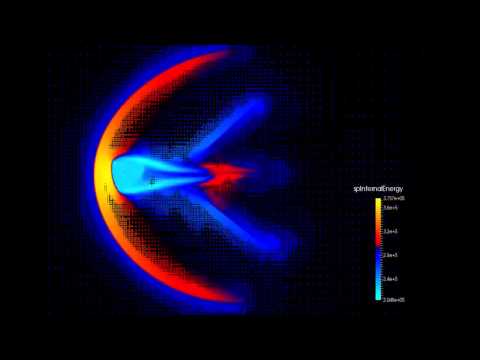
GPUs to Mars: Full-Scale Simulation of SpaceX's Mars Rocket Engine
About this video
SpaceX engineers present at NVIDIA's GPU Technology Conference on a multi-physics code that simulates the full-scale Raptor methane engine. It covers GPU-based turbulent combustion modeling with adaptive grids and wavelet compression.
Why it appears in the archive
HN points to it as evidence of SpaceX's serious simulation capability and as a showcase of GPU compute for CFD.
AI-generated summary and labels from the source dataset; verify important details against the video. Source & credits.
From the Hacker News discussion
The key was the full scale combustion simulator software that SpaceX developed to design the Raptor. This talk was given at NVIDIA GTC 2015 and inspired me to go into manufacturing [VIDEO] title: "GPUs To Mars: Full Scale Simulation of SpaceX's Mars Rocket Engine"
Read original comment ↗Here's a fun recent link: [VIDEO] Plenty more options to explore in the links under the video, starting from [LINK] Then there is NVIDIA's CUDA Zone with lists like [LINK]
Read original comment ↗There are bigger optimizations than 10X with some of the adaptive grid / wavelet compression stuff. I think these are still 2D, but pretty amazing: [VIDEO]
Read original comment ↗There are bigger optimizations than 10X with some of the adaptive grid / wavelet compression stuff. I think these are still 2D, but pretty amazing: [VIDEO]
Read original comment ↗I remember that. Fluid dynamics is a very tricky thing to model and the work they did was really cool. There's a good video presentation on it here: [VIDEO]
Read original comment ↗Or maybe it is that SpaceX is doing simulations on a level ahead of what everyone else does. Here's one of several amazing videos from SpaceX simulations. (There are more, but I don't have the link to the others) [VIDEO]
Read original comment ↗How about you also copy the sentence that lies just between those two? "As land slowly settles to a new position over time, the damper neutral position can be adjusted accordingly." And if that doesn't work, the tube can have some kind of rails or just to roll over wheels on top of the pylons. (my own thoughts as non expert) Rocket engineers with advanced simulation tools[0] have been working on this for 5 months before releasing the paper. Do you really think they somehow missed this obvious issue? [0] [VIDEO] Edit: Further in the paper it says: "The tube will be supported by pillars which constrain the tube in the vertical direction but allow longitudinal slip for thermal expansion as well as dampened lateral slip to reduce the risk posed by earthquakes." So pretty much what I've said. The other quoted sentence refers to placement of pylons themselves.
Read original comment ↗> that would be complex and severely impact performance on GPU architectures Agree about the complexity. However, adaptive grids can be a huge win in terms of performance. The GPU doesn’t need to simulate the whole 8G grid nodes, it only simulates much fewer nodes, only in the areas of large gradients / higher frequencies of the simulated fields. Here’s an old SpaceX presentation about their GPU simulations of rockets: [VIDEO]
Read original comment ↗